

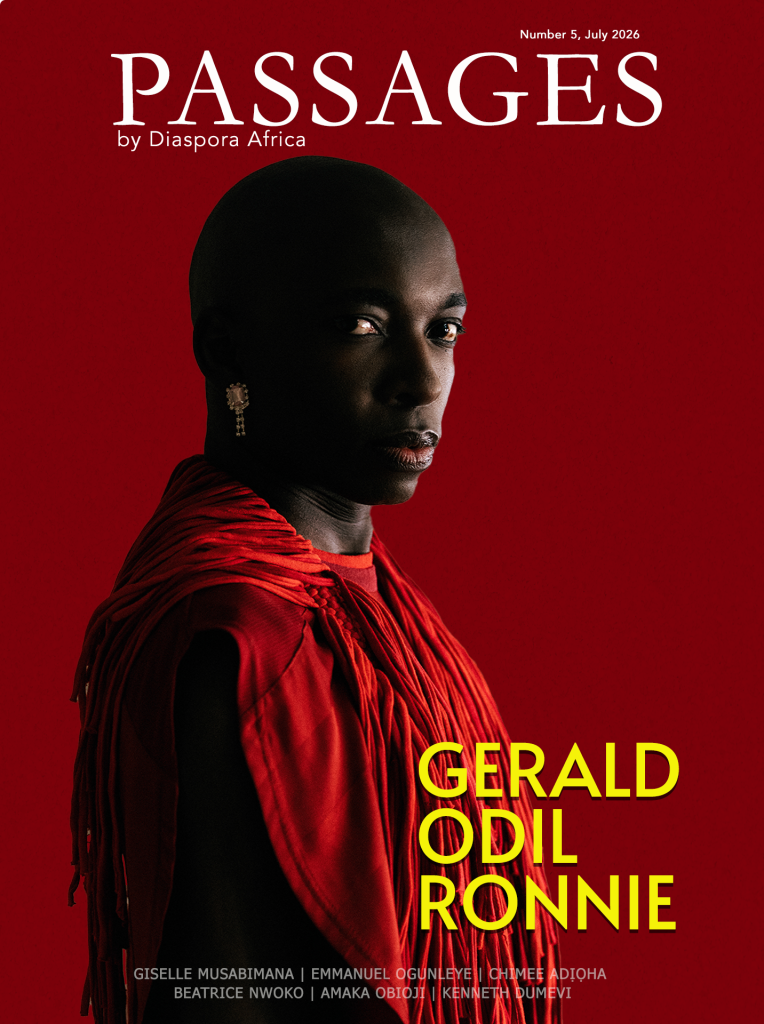
Gerald Ronnie Odil is a Ugandan multidisciplinary curator and creator whose artistry and identity defies strict norms. Before the Uganda’s Anti-Homosexuality Act passed in 2023 and irremediably affected their life, Gerald could not have imagined living anywhere else in the world. “Something terrible could happen and then, in 15 minutes, I’d just be on a boat somewhere over the lake. The sun is shining, there’s plenty of fruit, and I had people I loved close to me. I didn’t want to be away from them” they said. Love held them there, and that was enough. But when the place they loved and homed turned “the mouth of the shark, the barrel of the gun”, it became impossible to carry on the life that was once deemed tolerable.
Migration had already touched Gerald’s life long before they were born. Their family is of the Lang’o tribe, originally from Northern Uganda, who later moved South, where Gerald was born. “So before I was born physically, I was born somewhere else”. Through the experience of exile and resettling elsewhere, Gerald started reflecting on whether they had ever felt grounded when “home”. Growing up as an unconventional and “completely gender-divergent” kid with a strong interest in the arts in a household of doctors, accountants, and teachers, they often felt they could not fully make sense of who they were. Music and dancing pervaded Gerald’s family subtext, but they were the first in their family to pursue the arts seriously. They began attending church choirs with their siblings at the age of six and later went on to pursue theatre. Gerald’s mom spotted their talents and pushed them to continue. “A soft push”, they recall, that prompted them to continue with choir practice well into university years while also weaving through different sorts of artistic practices.
After moving to Kampala and growing into adulthood, Gerald experienced many other “rebirths”. From acting in theatre and training as a dancer, they went on to pursue more curatorial artistic practices where they joined forces with some friends and formed the collective ANTI-MASS. The space emerged in 2018 and quickly grew to become the spotlight of Kampala’s alternative partying scene, providing a series of electronic music explorations and experimentations. “We wanted to make a space that we kind of had control over in a way where we were centred”. ANTI-MASS evolved from a DIY response to nightlife, to a counter-heteronormative platform welcoming LGBTQ+ DJs, producers and performance artists, and committing to create a safe haven for queer lives in Uganda’s growing state-backed repressive homo-transphobic climate.
The work with ANTI-MASS opened up opportunities beyond the music scene, leading Gerald to broaden their practice. In 2021, they received a fellowship with 32 Degrees East and got involved in Kampala’s public contemporary art festival KLA ART. “It was really an invitation for artists to think about the city in which they live. Uganda specifically is a hard city for artists to express things in public, for anyone really, artists, advertisers, anyone to show anything in public that isn’t pro-state”.
However, against the backdrop of the mounting targeting of the LGBTQ+ community, the lives of Gerald and their loved ones within and beyond the collective came under ever-tighter scrutiny and policing. The home they shared with their partner was raided several times. “One time we woke up with men with AK-47s knocking on our door in the middle of the night and asking us if we were homosexuals”. ANTI MASS’ events started being constantly shut down by the police, making organising more uncomfortable and unsustainable. With the passing of the Anti-Homosexuality Bill, all the jobs Gerald had lined up were unwilling to take them on. In 2024, they finally decided to leave Uganda, as the last one from the whole ANTI-MASS collective to leave the country. They obtained a fellowship through the Martin Roth Initiative, which supports at-risk artists and cultural professionals, and relocated to Munich, Germany. “By the time I left Uganda, I had been living in survival mode for a very long time”, they share, “And I don’t think I have learned how to expand myself beyond survival”.
Gerald never expected the hard impact this migratory process would have had on them. When migrating to Kampala from their village, they still navigated within and across the same system, the same social codes, where “time moved in the same way”. Despite having settled in Munich for the past two years, time feels compressed. “When I came to Munich, it didn’t feel like I’d arrived. It never felt like I’d arrived for a very, very long time”. In this foreign space, there’s lots that is required to get accustomed to, so much so that they almost feel like a lost, disoriented teenager whilst being in their 30s. In their artistic practice, they are now discovering a new approach to artistic creation in Europe, one that is more individual and solitary, as opposed to the more communal methods to which they were accustomed in Uganda. They perceive the overarching Eurocentric lens to art and practice, which tends to make very little effort to understand different ways of thinking or different worlds, and often struggles to find what it doesn’t know interesting.
During our chat, Gerald talks about the different levels of guilt that this newly attained “safety” bestows upon him. “Ive been thinking a lot, not trying to stay in nostalgia, but thinking about the work we were doing, but also how to move on from that point because the ground underneath our feet has shifted completely and the politics of that as well”. Hailing from a context with fewer means, they often feel overwhelmed by all the available resources in the academy: “I keep on thinking about so many things I have, and people who I think this opportunity could serve. I think about them so much because they deserve to be in a safe place, too. But many people don’t have passports. So who gets to leave the country, you know? Thinking about it, even people who can take a flight from East Africa to Europe, to America, anywhere, there has to be an amount of money that they have, a certain financial space they’re in, if they’re doing it personally, or a connection to funding to do something like that, to even claim asylum or refugee status. Then there’s the visa issue because it’s a whole regime in itself. So even when you have the resources, I mean, who gets to constantly apply for visas? And also, when there are calls to invite artists or different creatives to Europe or to America, what kind of people are they picking? What kind of applications are they excited to invite? And it’s not always the people who you think need it the most”, who gets to emigrate? Who gets to leave the country and be safe?
Gerald has yet to fully unpack their migration process, despite feeling all its marks “on their body and psyche”. Nevertheless, through this process, they have started to make sense of a newer understanding of “homing”. In our chat, they quote a friend who told them: “You are born multiple times, and everywhere you go, you end up rebirthing over and over and over again”. In this new rebirth through exile, Gerald finds that through the hardship that often tempts them from showing up properly to themselves, they are discovering their strengths after being suppressed for so long. “That’s why I feel like a teenager, like, oh my God, I can actually do this. I can do hard things, you know? And I have to remind myself that I can do hard things. And that takes time, and grace.”
In their practice, they started working more with sound in an attempt to honour some of the more ephemeral parts of their work, translating their artistic language into something that can be immediately felt, rather than directly said. And the ANTI MASS collective continues to work together, transnationally, despite being physically separated. While many members are still working to settle down and find a semblance of stability, they still organise and come together to help their community back in Uganda, raising funds for accommodation, supporting those who have been arrested and helping them get out of prison.
Resisting and organising “as quietly as possible”.
- The Anti-Homosexuality Act was passed by the Ugandan Parliament March 2023, criminalizing consensual same-sex conduct to varying degrees, from life imprisonment to death penalty. The provisions also apply to anyone advocating for the rights of LGBT people, including representatives of human rights organizations or those providing financial support to such organizations (Source)
- Excerpts taken from Warsan Shire’s popular poem “Home”, from her poem collection Bless the Daughter Raised by a Voice in Her Head: Poems (2022)
Writer:  Giselle Musabimana
Editors: Chimee Adịọha, Amaka Obioji
Design:  Emmanuel Ogunleye