
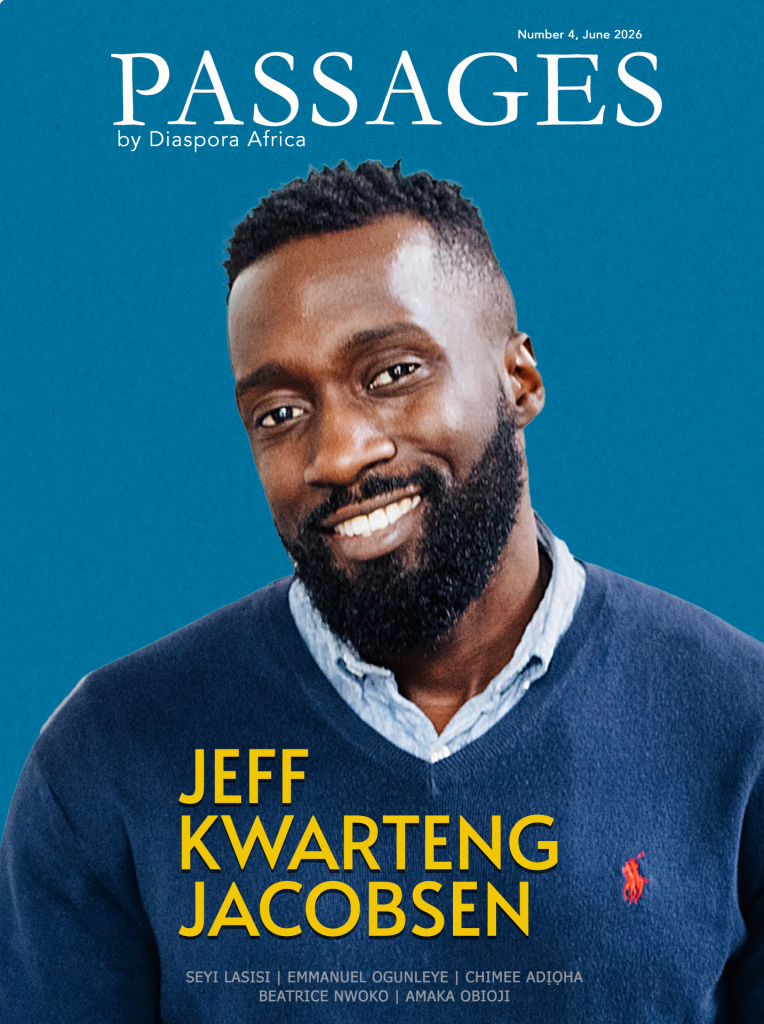
When Jeff Kwarteng Jacobsen visited Ghana, at age 14, what he felt wasn’t anger but deep recognition. At that age, he was visiting his ancestral country after his Ghanaian parents had migrated and birthed him in Germany. Traditionally, second-generation immigrants often grow up with a highly curated version of their ancestral homeland. They grow and live through their parents’ nostalgia, sparse local language use, and fragmented, censored and filtered out stories. To these second-generation immigrants, the homeland exists as an idea before it exists as a place. Thus, when they visit, the gap between the imagined and the real can be disorienting and deflating. The philosopher and cultural theorist Stuart Hall wrote extensively on how diasporic identity is never about returning to a pure origin but about negotiating between multiple, often contradictory, belongings. For Hall, the diasporic identity is structured around “the endless desire to return to lost origins.”
Hall describes the desire for the homeland as insatiable because the homeland exists more as an imagined community than a recoverable place. But, when Jeff visited Ghana, the feeling of “recognizing, very quietly but very clearly, this is also me” was dominant. In different aspects of his life, when a new experience presents itself even if they hold minute uneasiness, they make sense on a deeper level. The anticipation gave way for understanding. “It felt like I was beginning to understand my parents more deeply, how they grew up and what it meant that they built a life in Germany under very different conditions. That feeling stayed with me because it gave me a new perspective on my own life. It made me see that the opportunities and stability I grew up with were connected to sacrifice and effort that began before me.”
This recognition created a sense of responsibility and thinking that being the best version of himself could never only be about personal success. There must be a sense of communal success and thinking injected into his personal success. Success, after that first visit and subsequent one, morphed to mean asking what he could carry forward and give back. “It is the feeling of understanding that my life stretches across continents and that I come from one reality, was raised in another and have a responsibility to build something that honors both. In that sense, home is not just where I come from or where I live. Home is the inner commitment to create something that connects and benefits both worlds.”
The root of the systems and institutions he has created to help Afro-Germans deal with socioeconomic barriers can be traced to that first visit. During his bachelor’s degree, he had a foggy direction and roadmap of what he wanted to do. Added to this is the absence of an experienced Afro-German who shares similar life realities to turn to for guidance. But, that began to change when he got accepted into a highly competitive student consultancy as the sole black student.
“For the first time, I found myself in an environment where people had clear goals and actively supported each other’s personal development. That experience stayed with me because it showed me how much access matters. It made me realize that many socioeconomic barriers are not only about talent or effort. They are often about lack of access.”
This lack of access to mentorship, guidance, role models, professional networks and capital and opportunities have defeated and compelled talented people into “talented ruins.” Jeff realized that children of African descent in Germany struggle in school and can’t level up their classmates’ performance. This wasn’t because they’re less intelligent or talented but “rather because they are born into more challenging socioeconomic environments.”
To solve this and create an alternative reality where Black people have dedicated space for growth and potential-watering systems, motivated him to co-found Future of Ghana Germany (FoGG) with the initiator Lucy Larbi and others. “We wanted to make Black people visible in spaces where they are often underrepresented, while also creating role models and opportunities for the generations coming after us.” “Vorbilder” (role models) was launched as a space where young black professionals are given the opportunity to become mentors to children who live in Germany and have an African background. The space actively took up the responsibility of contributing to the empowerment of children and young adults that have a similar background seriously.
The success of FoGG evolved naturally into the diaspora organization AiDiA. FoGG was about visibility and community, AiDiA became about access and connecting Black founders to the capital and ecosystems they need to build and scale businesses across Germany and Africa. “On a personal level, this work gave me purpose and a deeper understanding of the kind of impact I want to have. It showed me that lived experience can be turned into institution-building and community-building. For the African diaspora we hoped to serve, the benefit has been in creating spaces of belonging and opportunity, spaces where people are not only supported but also encouraged to build their own initiatives and help move the community forward. Our work was about expanding what people believe is possible for themselves and for our community.”
The organization has carried out its annual Startup Pitch Competition since 2022 where Black and Afro-German founders present their business models on a public stage before a panel of investors and industry experts, with prize pools reaching €53,000. This flagship which has run three editions (2022, 2023, 2024) also doubles as a cultural gathering, incorporating live acts, Afrofusion cuisine, and an afterparty, deliberately blurring the line between economic institution-building and community celebration. Alongside the pitch competition, AiDiA runs AiDiA START, a six-week digital entrepreneurship programme specifically designed for first and second-generation migrants from the African diaspora in Germany. The free-of-charge virtual programme is structured around practical modules covering entrepreneurship basics and the specific complexities of founding a business within the German system. Participants are coached by people with migrant and diaspora backgrounds, and graduates are fed into an alumni network with access to mentoring, crowdfunding support, and future AiDiA events — effectively creating a pipeline from beginner entrepreneur to ecosystem participant. There are several initiatives geared towards achieving AiDiA’s goal of connecting “German economic interests with opportunities in Africa through the expertise of the African diaspora.”
In August 2025, Jeff wrote a Medium post titled From Roots to Branches: The Diaspora’s Big Role in 2050. In this essay, he wrote that the diaspora is no longer just a bridge nor transit point but a human-holding foundation. The turning point was co-founding FoGG in 2015, which is now Boldly. Launching FoGG allowed Jeff to stop seeing diaspora as something abstract but real and capable of being built from. What changed, for him, was that an idea became an institution and that made a big difference. Once something is institutionalized, it moves from aspiration to structure, from intention to something people can join and shape. Additionally, being part of a like-minded and deeply committed team gave him a new confidence that Black people are capable of creating community-driven impact. Knowing that we had each other’s backs and were driven by a shared sense of purpose created a different kind of confidence. The shared sense of purpose showed him and his fellow founders that diaspora is not only about identity or connection. The diaspora can also be a source of collective strength and forward movement. “We were creating an environment where people could push each other toward stronger careers and greater confidence in what was possible for them. That matters because diaspora should not only be about community, it should also be about access and the ability to move upward in the social and economic space. What we created was meaningful for us personally but it also became part of something bigger. It helped build a wider foundation that allowed others in the diaspora to see new possibilities and pursue opportunities with more confidence. In that sense, it became a kind of blueprint that other diaspora-led organizations could also build on. So the bridge stopped being a transit point when I saw that diaspora could become lasting community infrastructure, something that does not only connect people but enables them to grow and gain influence together.”
In a LinkedIN post, he mentioned that dual citizenship is a ‘strategic’ move. This mindset contends with the sense of cultural and psychological displacement and tension migrants carry. This dual citizenship framing is a way to teach African migrants to view their identity not as a ‘crisis’ to be solved, but as a ‘strategic asset’ to be deployed. Personally, what Jeff tries to teach the next generation isn’t just asking “Where do I fully belong?” but also, “What can I build because I belong in more than one place?” For him, that shift changes everything and moves identity from being a crisis to being a source of possibility. “When I say strategic, I do not just mean legal status or mobility, I mean leverage. Belonging across borders can expand your economic agency, your democratic participation and your ability to move knowledge, ideas and opportunities between different contexts. That is why I believe diaspora identity should not be seen as something to simplify or overcome. In my opinion, it can be an asset when you learn how to use it with purpose. I think many young people in the diaspora first experience identity through tension. They may feel in-between, misunderstood or pressured to choose. However, I would tell them that being shaped by more than one world can also give you a wider perspective. It can help you understand different systems and see opportunities others might miss. That is not a weakness. That is a form of capacity. For me, that is where the power lies. Identity becomes strategic when it helps you create access and contribute across borders, not only for yourself, but for others as well. So my message would be do not treat your identity as a problem to solve. Treat it as a position to grow from and eventually as an asset you can use to help shape the future of the communities and countries you are connected to.”
Jeff moves between Ghana and Germany. When he’s on a flight between Berlin and Accra, he doesn’t feel like he’s choosing between two versions of himself. In many ways, this in-betweenness is space where he feels most complete. It is where the personal and the strategic come together. Over the years, he naturally thinks about what can be built between Ghana and Germany, how relationships can be strengthened, and where new opportunities are emerging. This informed how he sees the world. Beyond the strategy, these journeys are also personal. “They reconnect me with a part of myself that is rooted in a wider sense of responsibility. And honestly, when I land in Accra, I have to smile. I smile because I know I am about to have a really good time, to reconnect, to be in that energy again. But I also smile because I can already foresee some of the stress that will come with being in Ghana and I mean that in a loving and funny way.”
What makes Ghana meaningful is that it is a place of encounter. The landscape allows him to meet and connect with diaspora people from different countries and national backgrounds but often have very similar questions and ambitions. “Those conversations matter a lot to me because they expand the horizon. They remind me that diaspora is not only about my own story or even only about Ghana and Germany. It is also a wider global community of people trying to connect identity and opportunity across borders. That is often what stays with me on the flight back to Germany. I return with a stronger sense of urgency.” The conversations in Ghana and the exchanged perspectives sharpen his feeling that more can and should be done, not only for Ghana but also in Germany. They force him to think more seriously about what needs to change and how diaspora perspectives can create value in both places. Thus, when he returns to Germany, it isn’t with memories but momentum. “So the version of Jeff sitting on that flight is not one person leaving and another arriving. It is someone who understands that movement itself can be productive. That journey becomes a space of reflection. I am not travelling between two separate selves. I am moving within one larger purpose, one that is shaped by both Ghana and Germany and strengthened by the people I encounter along the way.”
In his corporate career, he was conscious, early on of how much of his background and perspective walks into corporate spaces with him. That consciousness wasn’t hinged on hiding his African-ness but translating parts of himself into a form that would be understood and accepted. In Berlin, for instance, there’s an unspoken idea of what professionalism looks and sounds like. Thus, when you come from a diasporic background, it’s easier to notice how everyone enters those corporate spaces with varying levels of confidence or ease. At the beginning, he wasn’t that confident partly because of imposter syndrome and the recurring experience of often being the only Black person in the room. The latter factor comes with a certain self-awareness. In those contexts, you’re not just concerned about doing an excellent job but navigating whether you are being fully seen as someone who belongs there.
In Jeff’s experience, he also had to adjust to the culture of consulting itself. The consulting world expects you to challenge ideas and push back directly, even with senior people. His African background had instilled a strong cultural sense of respecting elders and authority and not speaking against them. Being the youngest person in the room, that was not always easy for me. But, over the years, he has learnt that in professional spaces, respect and critical thinking are not opposites. “You can challenge someone seriously and still do it with respect.”
Access to consulting is difficult, which means it’s monopolised with people from privileged backgrounds. When colleagues would casually talk about skiing, holidays, second homes or forms of access and exposure during lunch or breaks, it contrasted with his upbringing and economic reality. Those moments make him aware of the distance between their realities and his. “There were times when it felt strange to speak openly about my own background because somewhere in my head I did not want to appear different or like I did not belong. What is interesting is that many of the things I once felt I had to manage or translate have become some of my greatest professional assets. One is the ability to move between different worlds and read situations from more than one perspective. Another is resilience because of the life realities I came from, I learned early not to fold under pressure. That does not mean everything always worked out but it does mean I developed the ability to stay steady in difficult or high-stakes situations.”
Reflecting on his career and personal life, the parts of himself that he had to quiet down have morphed into a source of strength. “My African-ness gave me resilience, perspective, social awareness and the ability to navigate complexity without losing myself. What once felt like something I had to carefully translate has become something that helps me bring value into the room in a way that is both professional and deeply grounded.”
Jeff has navigated the world with a sense of responsibility towards himself and his immediate community. That has been translated into FoGG and grown into AiDiA. When quizzed about what he would tell the teenagers he mentors he wished had been said to him, he encourages them not to allow other people’s limited imagination become their self-image. “At age 15, you are still forming your view of yourself and a lot of that happens through the environment around you. You listen to what people expect from you, what they think is realistic for you, how they respond to your ambition and whether they see your potential. If you are not careful, those outside limits can slowly become inner limits. That is why this message matters so much to me when I speak to mentees today. I want them to understand early that just because the world around them may not always reflect a big vision for their life, that does not mean they are meant for a “small life”.”
As he has learnt, the problem isn’t always their potential. Sometimes the problem is that they grow in environments that limit their imagination. This is what makes it important to protect their mind early. “The way you think about yourself shapes the decisions you make. It shapes how much you try, how much rejection you can handle, what opportunities you believe are for you and how seriously you take your own future.” When your immediate environment cannot yet show you what is possible, books can. Literature quietly gives you access to a life compass and bigger ideas. “That is also why I think reading early and reading a lot is so important. Reading helps shape your mindset. It gives you language for things you feel but cannot yet explain. It widens your horizon and helps you make better decisions.”
As we end the conversation, he wants the young Afro-Germans to know that having a more complex path does not mean they are behind. The complexity often means they are learning things early that will become strengths later like resilience and adaptability. “Those strengths only become useful if they do not start doubting themselves too soon. That is why I would want them to build confidence early, saying “my path may look different but that does not make it smaller.” They should build their mind and trust that their future can grow far beyond what others currently imagine for them.”
Writer:                 Seyi Lasisi
Design:                 Emmanuel Ogunleye
Editors:                Beatrice Nwoko, Amaka Obioji, Chimee Adịọha
PASSAGES is dedicated to amplifying and platforming African migrant voices globally. All our content is free and accessible to everyone. If you enjoyed what you read, please consider supporting us. Your donation helps sustain the work of our writers, editors, and designers and makes it possible to bring even more voices to light.

DONATE HERE