

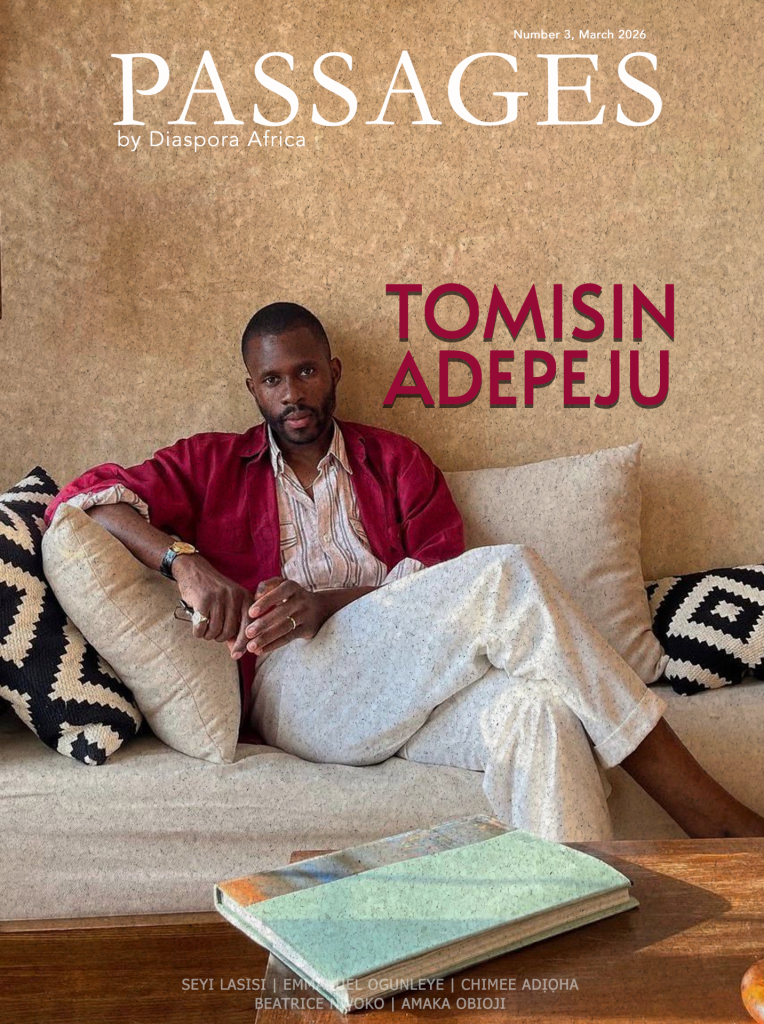
Tomisin Adepeju moved to England with his parents at 12 years old. Prior to moving, he was exposed to Nigerian soap-operas that aired on Nigerian television stations and American films. 24 years later, the Nigerian Television Authority(NTA)’s Super Story’s opening theme song’s lyrics are still etched on his mind. “This is Super Story, a life of strife and sorrow….,” the filmmaker recalled in a recent conversation with Diaspora Africa. He recalled watching Paul Verhoeven’s masterpiece Starship Troopers as a 10 year old and describes it as a truly unforgettable experience. The story, themes and plot served allure for his impressionable mind. When he got to England, he felt a loss for the community he had left behind and struggled to fit in. In this mental and psychological moment, films became his escape. “All I looked forward to was going home and watching films. I would watch the British and American films that would play on TV on Saturday and Sunday nights. Film is such a powerful medium; from my flat in South London, I would travel to all these countries around the world,” Adepeju recounted.
At age 14/15, he had an epiphany: the films he had been watching and loved were definitely directed by someone. This epiphany will play a crucial role in his life and career pathway. Interestingly, he was watching productions by Steven Spielberg and Martin Scorsese and was inspired that these directors have created their own cinematic language and universe. Their crafted worlds that had a singularity of vision and voice further motivated his young mind. Years later, that single epiphany guided him to study Film and TV theory at Royal Holloway University for his BA and for his Directing Masters, he attended Met Film School; a completely transformative experience. “I was exposed to the work of Jean Luc Godard, Francois Truffaut and the French New Wave, to Vittorio De Sica and Italian Neorealism, to the work of Mira Nair, John Ford, Ingmar Bergman…filmmakers that would shape my artistic sensibilities.”
Film school has been known to further shape the artistic sensibilities of story-conscious individuals. However, for Adepeju, film school didn’t further shape his storytelling instincts, it helped fight back at racial trauma he was carrying. When he first moved to England, he was made to feel Nigerian culture wasn’t important or valid. His accent was teased and he was told to go back home. There was a period in his late teens that he attempted to shed off his Nigerian roots and identity for the more digestible and socially-approved British identity. Karen D. Pyke, a sociologist, in her social justice studies describes this as internalized racism – “a form of internalized oppression by the racially subordinate.” Robin Nicole Johnson, in her study, The Psychology of Racism, emphasizes that internalized racism involves both “conscious and unconscious acceptance of a racial hierarchy in which a presumed superior race is consistently ranked above other races. In 1903, African American civil rights activist W. E. B. Du Bois wrote about the existence of “double-consciousness“to explain American racial minorities’ self-perception as heavily influenced by the white majority’s perception of them. The Black is Beautiful movement in the United States further dispelled this generational-baton-down internalized racism and racial trauma. Fortunately, cinema and film school helped Adepeju contend with these racial realities and questions. A lecturer had asked him what kind of filmmaker he wanted to be. This conversation and question made him realize he wanted to make personal films that reflected his identity, culture and experience. “This whole process was really quite therapeutic, I began to interrogate my identity, roots and upbringing. At the end of this period of self-reflection, I completely embraced my Nigerian identity and worked really hard to tell stories that captured my culture from a diasporic lens and perspective. I love cinema because it’s allowed me to confront my past and my present journey and made me more aware of who I am and my identity.”
This anecdote, for anyone who has seen Adepeju’s works, explains the distinctive Nigerian sensibilities resident in them. Though set in Britain and resident there, the characters in his films are undoubtedly Nigerians. As he previously mentioned, they are characters that represent Nigerian culture and identity from a “diasporic lens and perspective.” Take Appreciation for instance, the short film captures the cultural ethos of a Yoruba naming ceremony and communal feel and atmosphere found in the safety of a Nigerian church. The close-knit nature of the church was woven into the character. As he told Diaspora Africa, the Nigerian sensibilities in his work is also ingrained by his parents who never allowed him to forget who he was. “The stories I now tell reflect a lot of the things I saw growing up, both in Nigeria and England. They’re tales of friends and family navigating loss, cultural identity, a crisis of faith. One of my favourite film-makers Michael Roemer once said that ‘Film at its best uses the language of ordinary experience but uses it subtly and artfully’”
Adepeju’s films, when further probed, reflect a longing for Nigeria and a reminder of his roots. The characters in his films(The Good Son,Omo Dada, Appreciation and Journey Mercies) are Nigerians who have chosen England as their adopted home. As a person and filmmaker, he’s fascinated by this decision. “I have often wondered why my parents made the decision to move in 2002, an event that profoundly altered the course of my life. What compelled them to leave? Will they ever return to the place of their birth? Have they forgotten who they are?” These are complex questions that he has ruminated over the years. These questions are personal but also universal. “They transcend cultural boundaries and are universal and that is exactly why I explore these themes and issues in my work.” After graduating film school, he watched a lot of foreign language films that played at prestigious international film festivals like Cannes and Venice and wondered, why Yoruba language films can’t be screened and celebrated at these festivals.
For teenage Adepeju, cine was an escape. As a more grounded adult and filmmaker, he describes cinema as a timeless, boundless universe where one can express their individuality, their vision of the world and see themselves reflected. This understanding has shaped the rhythm of his thoughts and interest in creating a distinctive style. During our conversation, we spoke about his perception about watching non-Western cinema as a film student and working filmmaker. “Non-western cinema has really informed my sensibilities, style and tone of my own work – it has also given me the boldness to express myself unapologetically.” Referencing Chika Anadu’s extraordinary debut B for Boy (2013) or Rungano Nyoni’s debut I Am Not a Witch (2017) or Ousamane Sembène’s short about class struggle in post-colonial Senegal, Borom Sarret (1963) or Youssef Chahine’s sublime Cairo Station (1958) or Alain Gomis’ transcendent Felicite (2017), he reflected on how these groundbreaking films changed his life.
A lifelong student of cinema, Adepeju watches, interrogates and studies cinema from different countries and continents. These films have further grounded his thoughts about the place of cinema in confronting political and social issues. As a filmmaker, he feels lucky being able to translate his ideas, thoughts and feelings through the moving image. “Most people don’t have an outlet to express themselves, there is something quite potent about films and the way they’re able to acutely distill timely issues around racial injustice, war, famine and other important issues.” Referencing African American Filmmaker and multidisciplinary artist, Cauleen Smith’s Drylongso, which he saw the morning of our chat, he detailed how the film follows the bond between two black women whose friendship unearths the deeply rooted racism that has pervaded the American consciousness for generations. One of the women, Pica, played by Toby Smith attempts to preserve the memory and existence of young black men in Oakland by taking polaroid snapshots of them. She does this because she is unsettled by the rate at which young black men around her are being killed. “This film was released in 1998 but this is sadly still a relevant issue in our society. Smith’s film, 27 years on, is a time capsule into a very specific place and time in history. An incisive exploration of how the past has shaped our present reality and what the future might hold.”
Watching films is a daily routine for the filmmaker. As a cinephile will agree, whilst watching films can be enjoyed as a solitary endeavour, it can also be enjoyed in a physical gathering. DAILIES, which he founded as an alternative space for curation, programming and holding conversations around films, was in pursuit of that communal experience. “Film is a communal experience and that is exactly why I founded DAILIES. I wanted to share my love of film with an audience of filmmakers, artists and enthusiasts.” The seed for DAILIES was born in 2018 when he curated three other Nigerian-British shorts that explored immigration, class, loss and identity alongside his film, Appreciation. “The fact that this screening was the genesis of DAILIES is not a coincidence, my identity and roots have always guided the choices I make and the trajectory of my career.” That screening experience where Nigerian-British stories were celebrated made him realise that he wanted to anchor DAILIES around in-depth discussions that resulted from the screening. Recently, he launched DAILIES CLASSICS where he will be screening programmes that ruminate on the power of cult classics, underseen gems and the groundbreaking films that have shaped the current cinematic landscape. Also, he organises DAILIESESSIONS for practical workshops and masterclasses.
As our virtual chat wind up, I asked him if, as a Nigerian in the diaspora, he feels pressured to have a familial line with filmmakers in Nigeria. His film, Journey Mercies, screened in Lagos, Nigeria during the S16 Film Festival and he has an unannounced work with some Nigerian creatives. That the film screened and resonated with a Nigerian audience at a Nigerian film festival was a dream come true. Over the years, Adepeju has formed a sort of relationship with C. J “Fiery” Obasi, Michael Omonua and Abba Makama, the co-founders of S16 Film Festival and other Nigerian filmmakers. “This bond is really important to me, we are united by our shared love of timely and bold cinema that centers Nigerian lives and stories.”
Writer:                 Seyi Lasisi
Design:                 Emmanuel Ogunleye
Editors:                Beatrice Nwoko, Amaka Obioji, Chimee Adịọha
PASSAGES is dedicated to amplifying and platforming African migrant voices globally. All our content is free and accessible to everyone. If you enjoyed what you read, please consider supporting us. Your donation helps sustain the work of our writers, editors, and designers and makes it possible to bring even more voices to light.

DONATE HERE