

Brexit. A recession too often dismissed as merely a “cost of living crisis”. Five Prime Ministers in seven years. Thousands gather at far-right riots while activists are jailed for pleading for humanity. Alongside this, a staggering rise in anti-migrant sentiment across the globe. Together, these events have marked a profound political shift in the UK and prompted many people to reconsider not only their future in this country but also the fragile contingencies that attach to their lives as economic migrants, refugees, asylum seekers, international students, or family members trying to build stability here.
At the same time, the painful reality remains that these communities are continuously met with shrinking alternatives and diminishing protections. For many households, that warning has already arrived at the doorstep, and in some cases, the door barely moved. Following the latest local election results, in which Reform UK secured outright majorities in 24 councils across Great Britain, it became impossible to ignore the growing political apathy toward issues that will inevitably affect us all. Although I cast my vote with immense pride and gratitude, many chose not to participate, while others actively supported Reform UK. In doing so, some appeared to forget that “it’s no use crying over spilt milk” — because regardless of political allegiance or personal beliefs, the consequences of these decisions rarely remain isolated to one group alone.
What many people also fail to recognise is that political participation in the UK is already deeply uneven depending on your immigration status. Settled migrants like myself are often limited to voting in local elections, if we are permitted to vote at all. In my case, despite living, working, and contributing here – not that I would ever minimise one’s inalienable rights to their position within an imperialist, white supremacist capitalist patriarchal society -, my ability to engage fully in what is often described as a “civic duty” remains restricted by law. Current voting eligibility rules continue to exclude large groups of residents from national political participation. While Commonwealth citizens are allowed to vote in all UK elections and referendums, EU nationals are generally restricted to local and devolved elections, and many other residents — including people from countries such as Japan or Algeria — are denied voting rights altogether despite building their lives in this country.
When I consider all of this, I cannot help but question whether people truly understand the weight local elections carry, particularly for communities already living with limited political representation. For many of us under the EUSS, stability has never felt guaranteed, and the prospect of increasingly hostile immigration policies only deepens that uncertainty. These elections are not abstract political exercises; they shape the conditions under which migrants live, work, study, and attempt to belong. And while some may view local politics as secondary, for others, it can determine whether they continue to feel safe, represented, and welcome in the place they call home.
From the Reform councillor suggesting that “Nigerian population in Sunderland should be melted down to fill in potholes” to another member of the party celebrating the racially motivated sexual assault of Sikh women, we have all been shown that fascism, hatred, racism and misogyny bolster one another and deliver nothing but the nation’s most vulnerable on a rusty platter.
According to the BBC, 171,000 people were added to net migration figures last year — roughly half the number recorded in 2024. “The figure is at its lowest level since 2012, excluding the Covid pandemic (…)”. Yet despite this significant decline, much of the UK’s political class continues to obsess over dismantling what they describe as “mass migration” and reducing the country’s reliance on foreign skilled workers, with Prime Minister Sir Keir Starmer insisting that there is still “more to do.”
By continually scapegoating migrants, there seems to be a growing willingness within Britain’s social fabric to remain oblivious to social housing shortages, a crumbling NHS, rising food costs and above all else, migrant dehumanisation. In many cases, migrants are framed as culturally incompatible and therefore somehow less deserving of empathy, dignity, or protection. The silence and inaction surrounding these narratives only further legitimise the dangerous belief that the right to rebuild one’s life on British soil should be reserved for those who possess a certain complexion, nationality, or socioeconomic privilege. There is a quiet comfort in this hierarchy — even if unconscious — that allows equality itself to feel negotiable, as though extending fairness to some would somehow diminish what others believe they are entitled to. And in confronting this reality, we are forced to question what mobility truly means for migrants as a whole.
Because if we were all standing in the same room — an American digital nomad living in Lisbon, a Senegalese seamstress settled in Paris, a British diplomat stationed in Nigeria, a nursing student from Guinea-Bissau training at a hospital in Milan, a German businessman living in Salvador, and a Congolese widow raising her children in Amsterdam after losing her husband in a minefield — who among them would be granted the privilege of pursuing a better life freely, and who would instead be met with suspicion, hostility, and the constant erosion of their humanity? Inevitably, we arrive at the uncomfortable understanding that mobility itself is racialised. For those of darker complexions and deeply rooted cultures, movement across borders is too often framed as a threat and opposition.
As I wrote previously in an article for Black Ballad, “Participating in democracy is a basic human right. Even though this may push individuals to attain citizenship and full voting rights, depending on the migrant group you belong to, accessing them can be quite intricate and costly. The UK sits in third place as one of the countries with the highest visa fees; citizenship costs almost £1,700 [now £1,839] per adult, and there are also hefty surcharges attached to an already struggling NHS.”
“For most migrants, these structural issues are accompanied by a sense of toxicity, obligating us to constantly justify our worth and dive into binaries of migration as we stand and evaluate which migrants are ‘worthier’ of voting rights. From how we contribute to the country’s progress to how useful immigration is, even when we are “legal”, the public discourse around our lives degrades us to chattel since it perpetuates othering narratives where migrants are only necessary when societies can reap the fruits of our labour.”
As someone who recently completed the Life in the UK Test, I often find myself questioning what guarantees truly exist that this same opportunity will not one day be taken away. It becomes difficult not to feel disillusioned while witnessing the alarming treatment of vulnerable young people being groomed into extremism and stripped of their citizenship, while at the same time watching powerful men accused of perpetuating violence and committing war crimes continue to evade accountability without consequence.
Even the possibility of obtaining a British passport and securing permanence here is a privilege in itself — one that countless people will never have access to. So, if I eventually decide to get my Portuguese passport and leave while envisioning a life elsewhere, I won’t stop thinking about those who do not have the possibility of returning home.
Empathy has to begin somewhere, and collective action through its lens can carry us much further than we often realise. While some of us may still have an escape route, many others do not. Those who fled simply to survive — because of war, financial hardship, drought, climate collapse, abuse, or circumstances far worse than many of us will ever experience. How can I sit and imagine a future for myself while others are left with nothing to fall back on? No safety net. No anchor to hold onto.
So, now imagine being forced to leave your home, your community, your career, and the life you built because the political climate became intolerable, all while knowing you did not use the little political power you did have when it mattered most. And though this might be hard to digest, this might be the road we are being led down.
Looking away because the discomfort still feels far enough removed does not make the situation disappear; it only delays the moment we are forced to confront ourselves. As I wrote in a previous article, “I strongly feel like, for those who can vote but feel hopeless, not voting shouldn’t be a solution. If you give up your voting seat, you best believe someone else will occupy it for you.” Because despite our individual thoughts on voting, the reality is that for many people across the world, this right is not inalienable, but a privilege — one that countless others are still fighting to access, protect, or simply survive long enough to exercise.
Overall, local elections remain one of the few democratic tools many of us still have access to, yet people continue to treat political disengagement as though it exists without consequence. Choosing to stay home or securing a passport does not create distance from the outcomes of these decisions, nor does it shield anyone from the realities that follow them. If anything, it simply leaves space for others to decide the future on our behalf.
Writer:       Jamila Pereira
Editors:      Amaka Obioji, Beatrice Nwoko
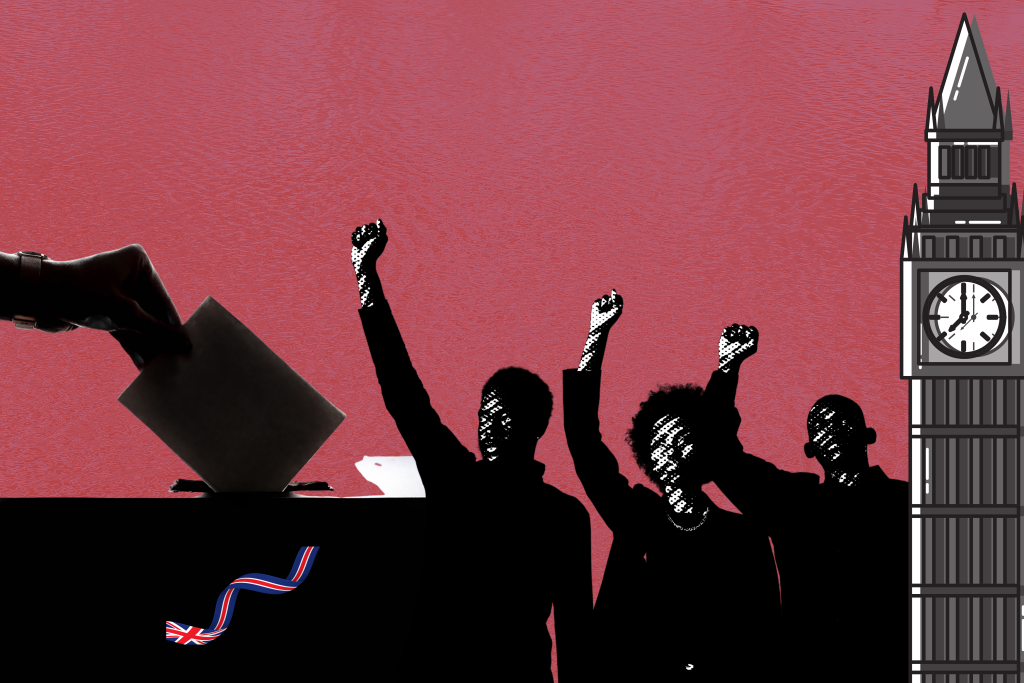
Illustration: Rukiya Mwangi/Diaspora Africa