

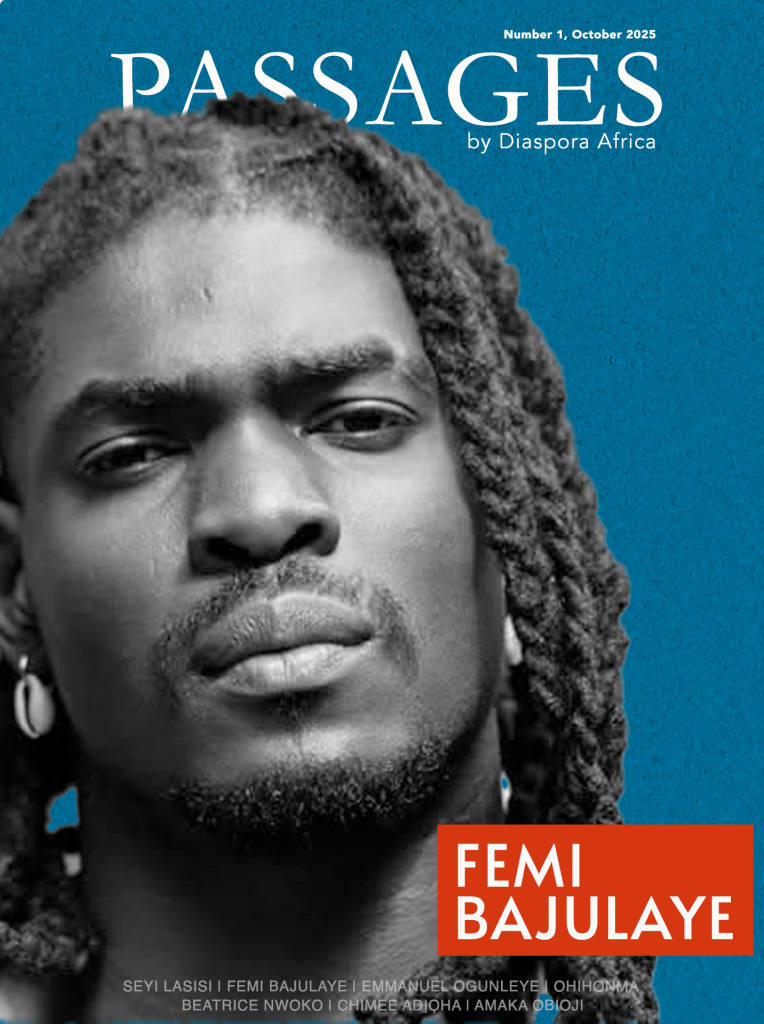
When multidisciplinary artist, Femi Bajulaye migrated to the United Kingdom with his parents and siblings in 2006, he was ten years old. Recalling events that led to their departure, he remembers feeling a sense of adventure on the horizon. His uncles and aunt had promised him endless possibilities should he be hardworking. Of course, his ten-years old mind couldn’t grasp the entirety of their words and its meaning. However, he was conscious of the impending change. “An air of innocence, a strange fear of the unknown that metamorphosed a spirited boy to a near insular one that for a while chose to only exist in his imagination,” was how Bajulaye described leaving Nigeria in a recent interview with Diaspora Africa. On getting to the UK, he wasn’t conscious of his “migrant” status until his parents tried enrolling him into secondary school. The tedious administrative process that required him to be approved as a student and the microscopic analysis of his parents’ ability to rightfully parent him and his siblings made him conscious of his “otherness”. Responding to this, young Bajulaye became quiet and introspective.
The emotional and psychological impact of this on a teenager is enormous, and as Bajulaye will tell Diaspora Africa, processing this, whilst young and innocent, and coming to terms with the dynamics of ones’ imaginations being micromanaged, makes the world claustrophobic. “It seemed for a while the notion of going on a school trip or navigating the world in a way that felt fertile with possibilities was nonexistent to me and my siblings,” he reflects. This mental limbo and uncertainty, as he continues, stunted his ability to dream without inhibitions. The looming and omniscient challenge of his “migrant” identity and reality enforces him to exist in rigidity, confined experiences, careful exploration and intuitive distrust of who he was, also what and who he wanted to be. “Deciphering all this at such a young age was not freeing, however it made me patient, reflective and reflexive and observant. It made me curious about myself, my lineage and cultural tendencies. So, over the years I have learnt to appreciate the path of self-discovery that it had set me on, and the mental fortitude gained from an increase of assurance in my identity and its rootedness in African lineage tethered by history and culture.”
Artistic expression, dancing, visual art and filmmaking, became his way of communing with his African ancestry. By making art steeped in African worldview, aesthetics, consciousness and ethos, Bajulaye keeps in touch with his roots. It afforded him the privilege to not just be an interloper in his ancestral identity but an active participant. This creative communion gives reverence to the past, retrace memories and ask questions. The artist believes there should be a curious and important attention devoted to seeking knowledge about one’s culture. “One of the social ailments that is plaguing our minds is the absence of being rooted, or worse being rooted in the wrong things.” In Bajulaye’s opinion, culture provides context and context brings clarity, purpose and vision hence why Africans in the diaspora, black people around the world are alchemizing a cultural renaissance and fighting to protect said culture. This creative renaissance is an act of re-membering and involves the natural and spiritual recollection of memory and ancestral roots. Personally, it’s remembering his great-grandmother (Iya Idanre) bathing him in water and herbs as a baby for physical and spiritual fortification or his grandmother(Mama Lago) nurturing him with stories. It is also asking his parents about the Idanre hills, the Arun River, Igba Iwa, the footprint of Agboogun and other cultural markers that reminds him and others that there is more to our roots and that they will always find ways to reinforce balance within. “It is all these collective memories and questioning that maintain the tether. The Olympian figures, the profound philosophies and ontological precision of Yoruba and African ancestral roots guide my exactitude, my depth, visual language and how I stay rooted.”
Bajulaye’s visual work, dance and film contest with the reality of migrants and migration. Discussing what “influences” this artistic and political choice, he said the idea of influences (whilst important) tends to limit the full understanding of the layers that guide artistic choices. As an artist, he finds the “migrant” reality as a natural extension of one’s reality rather than an influence. It’s a lived experience which the body and mind responds to. This explanation and understanding is important to capture his artistic choices. As he told us, the intention was not to be political but to excavate the very spirit of migration and hopefully provide some depth in just how much of a psychological landmine it could be when making such decisions.
Migrating from Nigeria to the UK is a direct and indirect political choice. The Romans and Anglo-Saxons can express how politically inclined migration can be. Bajulaiye’s artistic attempt to humanize the psychological and cultural complexity that Africans migrants face (in varying degrees), he believes, leads to an inward journey. In an era where there’s an onslaught of personified and identity laden stimuli, it is very easy to feel in limbo, mentally, physically and socially. A sense of lostness paired with a yearning for belonging can be detrimental and destructive. Yet, these are landmines that “migrants” face. African “migrants” are required to be submissive to inhumane realities and experiences just because they’re finding work, hoping to go to school or “proving” their value to the system. “These are inherently political topics, and yet that is not my aim, though I welcome it. Whilst politics is inevitable, and everything can be argued to be political, my concern is with the spirit, the being, the ontological and cosmological detail of what Ayi Kwei Armah would call “The Way”, our way and how that could provide a better footing in the world as Africans, wherever we may be.”
This conscious artistic and personal interrogation of his ancestral origin have made him more certain that as Africans we have always had a profound outlook on the being and the cosmos that predated our collision with the Western world. As an artist rooted in his ancestral roots and identity, this is liberating and inspiring. Additionally, it provides a therapeutic insurgency against existing prejudices to who we were at our origin and what we were able to accomplish as people who birthed civilizations with intent and ambition. Scholars like Babatunde Lawal, Bolaji Campbell, Moyo Okediji, Henry Drewel, Sophie Oluwole, Adéléke Adéè̳kó̳, Rowland Abiodun and others have provided strong foundations in Bajulaye’s belief that his Yoruba origins have extensively travelled through the transatlantic slavery to Bahia, Cuba, Haiti, Barbados, America etc., and the present webs of globalization, evolving without losing its spirit. “It has made me aware of the impact of our culture migrating through the sea and the universe. Migration is a much broader phenomenon, even though it has become a political pawn, it is important to note that not one entity on this earth remains stagnant.”
Bajulaye doesn’t feel burdened to deposit images, thoughts and totems of his ancestral roots in his works. It isn’t burdensome as it isn’t learning to integrate himself in Western or Eastern philosophies, histories and ideologies. African culture is beautiful, its thoughts and totems are complex, intellectually rich, spiritually dexterous, flawed and flawless. As he expressed, artists are constantly seeking inspiration, directly and indirectly, and Africa possesses a goldmine. For him, it’s a way of carrying on a memory and an almost archeological excavation that brings to light so many lost ideas and Africa’s Anthropocene. Bajulaye sees this as exciting because there is so much to learn and build from. It also implies that if we are willing to do the work our future can be bright because our past possesses so much brilliance. “We cannot continue believing in castigating those images, totems because they are of us. To castigate them would mean ostracizing ourselves from us, to be irresponsible with our inheritance. We have made marks on this earth which are sacrosanct, and if I can in some way weave those marks into my work as an act of preservation, of archiving, it inevitably becomes a form of evolutionary practice, that moves our culture and the way forward into present and future times.”
Art is crucial, not just to discourse but key to finding solutions to geo-political issues. It provides the tools to deal with nuances and probe issues with deeper intent. Art makes the artist perspicacious and for the willing artist, it’s an opportunity to contribute to the topography of change. Artists, unmindful of their decision, may answer this call in a way that directly or indirectly tackles these geo-political issues. As Bajulaye argued, that we are making art about us, our experiences, our nature, essence, our present and past is incredible, it is the catalyst for deeper understanding. “Gone are the days where we do not see the value in evaluating the cause and effect of instability, abject poverty, or cataclysmic and byzantine events in history that changed our course. As we are facing the past and learning from it, we are actively making history and reconfiguring our place in the world. That is an almost insurmountable task, (almost) meaning our creativity in reconfiguring and solving these issues is limitless. That is exciting to me.”
Nineteen years after migrating, Bajulaye still thinks about home. For him, home is an everlasting curation of the spirit, and his experiences have taught him that home is a crucial phenomenon to the human soul to conceptualize both within and without. It’s a space cradled by the warmth of safety and sacredness of communion. In his understanding and ideas about it, home should provide a sense of freedom that allows one to collide with the world. The idea of home has always been an evolving phenomenology of the spirit to a destination of some form of truth. “And I suppose the truth is that of never losing The Way, which Ayi Kwei Armah spoke of, wherever you may land or collide, as I am certain most migrants can attest to. The Way encompasses all, our culture, our memory, our history and stories, and all is in the spirit and if we can keep that, then home can be wherever you land without forgetting The Land. So, once again I believe home is an everlasting curation of the spirit. We must do our best to keep creating spaces that cultivate that and most importantly that makes our spirit feel safe.”
Writer:                 Seyi Lasisi
Design:                 Emmanuel Ogunleye
Editors:                Chimee Adịọha, Beatrice Nwoko, Amaka Obioji
Interviewee Headshot:   OHIHONMA
PASSAGES is dedicated to amplifying and platforming African migrant voices globally. All our content is free and accessible to everyone. If you enjoyed what you read, please consider supporting us. Your donation helps sustain the work of our writers, editors, and designers and makes it possible to bring even more voices to light.
DONATE here