

At the start of the fourth year of war in Sudan, the crisis was no longer just a power struggle between generals. It has become a systematic machine for grinding down human beings, dismantling the social fabric, and redefining the relationship between people and their basic needs. While the army and the Rapid Support Forces clash over the remnants of a devastated state, civilians pay the heaviest price: their lives, their dignity, and their children’s future. While millions have been displaced inside Sudan more than 1,530,376 people have found their last refuge in neighboring Chad , a country already suffering from poverty and desertification, which has transformed itself into the largest refugee-hosting region in the area. But today, as the war approaches its third year, these refugees face a new humanitarian catastrophe no less lethal than bullets: the specter of mass famine due to an international drought of solidarity.
Chad: A Poor Country Hosting a Global Crisis
Chad currently hosts nearly 1,530,376 refugees and asylum seekers, according to June 2025 statistics . Of these, more than 844,000 have arrived since the war erupted in April 2023 , prior to this Chad was hosting roughly 409,000 Sudanese refugees who had fled earlier conflict in Darfur. This staggering number means that one in every 13 people in Chad is a refugee. In the eastern regions bordering Sudan, that ratio rises to one in every three people. The Chadian government has kept its borders open throughout the conflict, a noble humanitarian stance but it has placed the country under unbearable pressure. The already fragile infrastructure, overcrowded schools , and collapsing health centers simply cannot absorb this influx.
But the deeper problem lies not with Chad itself, but with the international community, which has begun to look away from this tragedy. On April 9, 2026, UNHCR and the World Food Programme (WFP) issued an urgent distress call: a massive funding shortfall of $428 million ($289 million for UNHCR, $139 million for WFP). Without this amount, essential aid food, water, shelter will face “life-threatening” cuts in the coming months.
The “Survival Economy”: When Chaos Becomes the Norm
To grasp the scale of the catastrophe, we must look beyond the numbers. The war has not only destroyed cities; it has destroyed the entire “livelihood economy.” Estimates suggest losses of nearly $15 billion in GDP about 48% of Sudan’s economy, with 5.2 million people losing their jobs. But in Chad, this collapse takes an even more brutal form, as “forced survival economy” becomes a way of life.
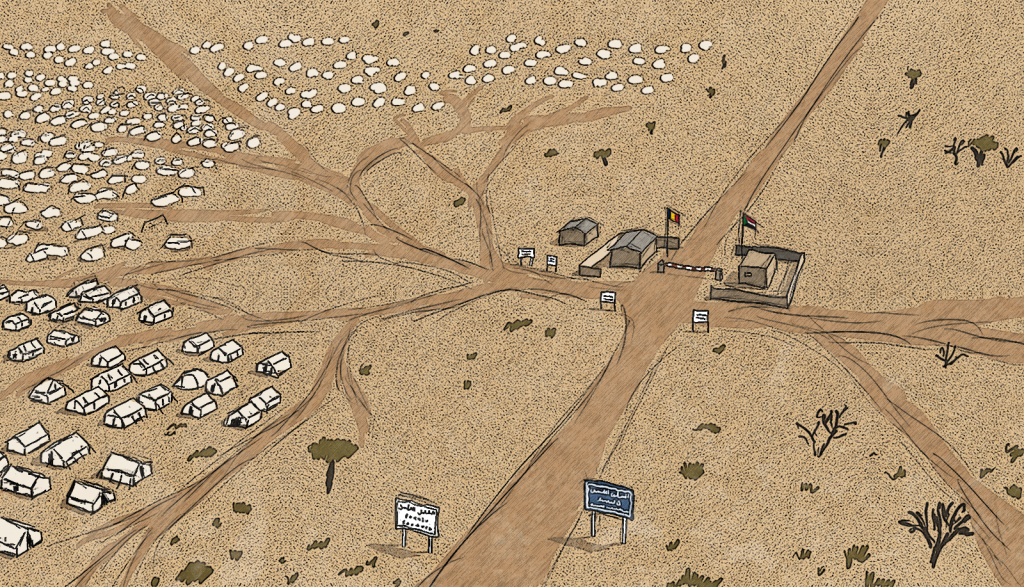
This new economy is measured not by what you earn, but by what you manage to survive on. Food is no longer a commodity but a rare lifeline subject to haggling. Water has become a tool of pressure, and health is a privilege for those who can access it. In the camps of eastern Chad, especially in areas like Ouré Cassoni in the Indé Est province, refugees live on less than half the daily minimum of water. Eighty thousand families are shelterless, sleeping in the open or under the burned branches of trees, as photos document.
Testimonies from Hell:
At the heart of this collapsed economy, we meet real faces carrying stories of daily torment. Mariam (40), a widow and mother of four, fled a small village in South Darfur after the city fell to the Rapid Support Forces on October 26, 2023. She sits today at the edge of a crowded market in the border town of Adré, her face marked by exhaustion beyond her years. Mariam used to receive monthly food aid that barely sufficed, but after recent cuts, there is no longer enough. She says, her voice laced with bitterness: “Before the aid cuts, we lived with difficulty, but now it’s impossible. I work double the hours I used to. I work as a cleaner in the market from dawn until dusk, carrying garbage bags and sweeping streets, just to provide a loaf of bread for my children. My body is tired, but my fear for them is greater. At night, I don’t sleep. I think about how I will feed them tomorrow.”
Salwa (30), a mother of five, lost her husband in the massacre that struck the city of El Geneina in West Darfur on June 14, 2023. Salwa now heads a household of seven (herself, her five children, and her elderly mother). She speaks in a voice devoid of tears. The tears have long dried up: “My husband was killed before my eyes. He left me with five children and endless sorrows. Here in the camp, my eldest son (12) has left school and works in the market, carrying goods on his back for a few coins. My little daughter (10) goes with me every morning to Chadian women’s homes to help them clean and do laundry, but the income isn’t enough to buy medicine. Every day is a battle to survive.”
Mohamed (45), a merchant who owned a shop in the El Fasher market, the capital of North Darfur state, before the city fell to the Rapid Support Forces on October 26, 2025. He fled with his large family: two wives and ten children. But the war showed no mercy; his first wife died during displacement due to illness and lack of medicine. His second wife now cares for the children and helps secure a modest income by volunteering with a small charity. Mohamed says, his voice choked with sorrow: “I had a shop. I was a respectable man. Today, I own nothing. My older children look for any daily menial work: digging temporary wells, carrying bricks, anything. The income isn’t enough to feed ten children. The yogurt that Chadian children eat is a dream for my children. I am terrified of watching my children die of hunger before my eyes, after I saved them from bullets.”
Climate Deterioration: A Silent Enemy Striking the Camps
Worsening the situation is that this humanitarian tragedy is unfolding in one of the harshest climatic environments in the world. Eastern Chad is a semi-desert region, subject to severe droughts, dust storms, and extreme heat. With water systems collapsing due to lack of funding, drinking ordinary water becomes a luxury. With every delay in moving refugees from overcrowded border areas (more than 243,000 people remain stranded there) to inland camps, the risks multiply: skin diseases due to lack of hygiene, heatstroke, and outbreaks of epidemics like cholera, which has struck Sudan and looms over Chadian camps.
Funding shortages have halted even basic environmental protection programs. There is no tree planting, no sand barriers, no waste management. Camps are drowning in garbage, turning into disease hotspots, while hot winds carry both illness and despair. These shortages are the result of deep aid cuts from the new U.S. administration and European donors shifting to defense spending which have slashed UNHCR and WFP programs in half, leaving only four out of every ten refugees with basic assistance.
The Final Plea: Before the Camps Become Mass Graves
The joint appeal issued by UNHCR and WFP in April 2026 is not just an ordinary funding request. It is a cry for help before it’s too late. Field indicators paint a grim picture: 70% of refugee families have been forced to reduce their number of daily meals; stunting rates among children are rising sharply; and fights over dwindling food aid are becoming daily occurrences.
Chad has become the world’s largest open-air camp, hosting survivors of genocide and severe hunger, while the international community watches. Aid cuts from the new U.S. administration, and European donors shifting toward defense spending all these factors have dried up the springs of hope. The stability of the entire Sahel region is now tied to what happens in these camps. If aid collapses, refugees will not only die of starvation; new waves of displacement will emerge, camps will turn into dens of despair and extremism, and borders will ignite once again.
The choice before the international community is clear: either act now to provide $428 milliona paltry sum compared to the cost of war or irregular migration or later bear responsibility for the crime of leaving more than a million people to die slowly on the doorstep of the 21st century. The war in Sudan has shown the brutality of humans toward their fellow humans. TheChad crisis is now testing our collective humanity. Will we pass the test, or will history record that we turned away while the world burned?
Writer:         Abla Salih Boush
Editors:        Amaka Obioji, Chimee Adịọha