

On a cold morning in the UK, Tunde slips out of bed before dawn. His phone lights up with messages from Lagos: a landlord demanding rent, a cousin seeking help with school fees, an aunt requesting money for medication. The weight of home arrives before sunlight does. He sighs, unlocks his banking app and sends money he had not planned to spend. It is a routine as familiar as breathing, yet one he never fully gets used to.
Across Europe, the United States, Asia and the Gulf, millions of African migrants wake up to the same rhythm. They live in one country, but their responsibilities live in another. Every month, sometimes every week, they are called on to stretch their income across oceans, carrying family burdens that distance has not erased. In these quiet, private acts of sacrifice lies a universal truth: long-distance love has an economy of its own, complex and often invisible.
Migration was supposed to be an escape for many; a chance to rewrite their story and breathe in a place where opportunity feels real. Yet leaving home did not sever the ties that bind. It only stretched them farther. And in that stretching, something profound emerged: a new form of love, measured not only in affection but in transfers, missed sleep, extra shifts and what one migrant described as the constant feeling that my life is split in two.
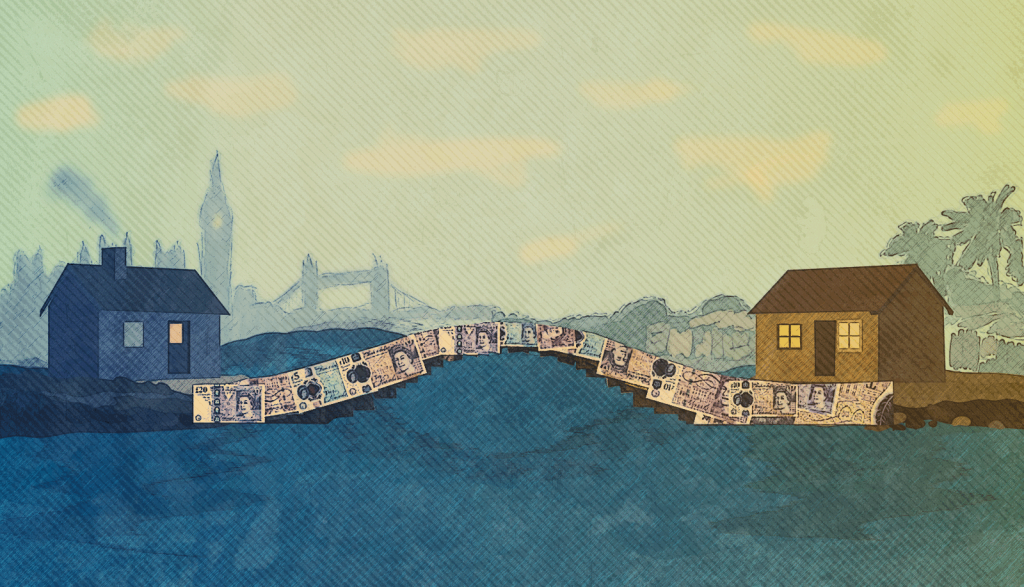
Where distance divides families, money becomes the bridge
Distance alters relationships, but money keeps them connected. In homes across Africa, remittances have become the backbone of family survival. The World Bank estimates that Africans abroad sent over $50 billion home last year—money that feeds families, pays rent, buys drugs, builds houses and keeps younger siblings in school. Behind this figure is a quieter story of personal sacrifice.
For parents raising children across borders, money becomes a proxy for presence. A mother in Rome funds her daughter’s education in Enugu, compensating for her absence with steady financial commitment. A father in Johannesburg pays school fees, buys uniforms and sends allowance because he is not there to attend parent-teacher meetings or birthday celebrations. For lovers separated by time zones and immigration restrictions, money plays the role that companionship cannot. A surprise transfer becomes a gesture of care. Paying for a partner’s course fee becomes an investment in a shared future. Covering rent back home becomes proof that distance has not diluted devotion.
But it is not always romantic. Sometimes it is duty, the kind that grows heavier with every request. Distance may weaken touch, but it strengthens dependence. Many migrants quietly hold up entire households, becoming the economic lifeline their families cannot do without. In this way, remittance is not just money; it is the sustaining thread in families stretched thin by geography.
The unseen emotional and financial weight migrants carry for those at home
Remittances are often celebrated as Africa’s hidden development engine. They are more stable than foreign aid, more reliable than government programmes and more impactful than most investments. The World Bank projects that African migrants will continue sending over $50 billion annually, a figure that exceeds the GDP of several African countries.
Yet behind the impressive numbers lie emotional stories that rarely make headlines.
The pressure to provide is woven into the migrant experience. The moment someone gets a visa or boards a plane, family expectations change. Migration is seen as an automatic upgrade in economic status. Even those in low-wage jobs abroad are imagined as people with abundant resources.
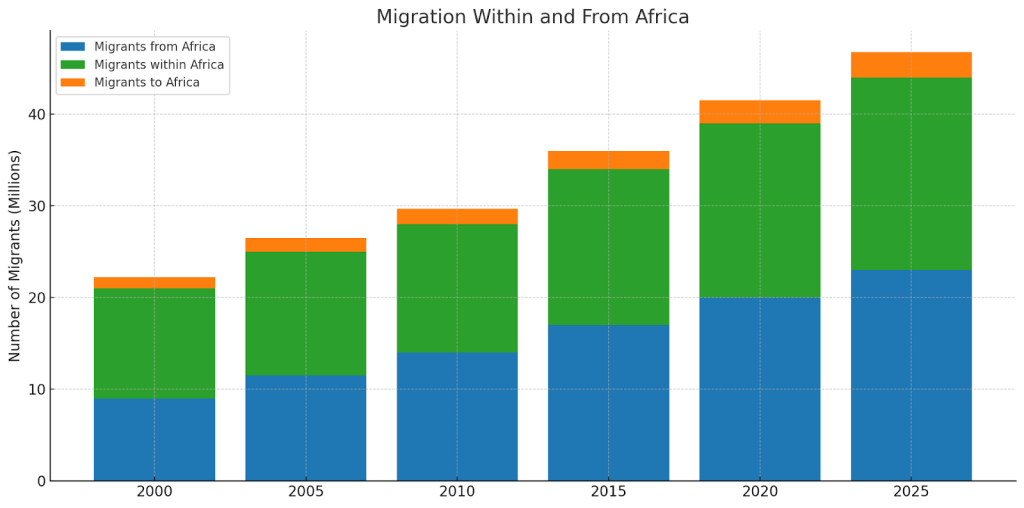
Source: United Nations Department of Economic and Social Affairs (UN DESA)
According to data from the United Nations Department of Economic and Social Affairs (UN DESA), migration involving Africa has increased steadily over the past two decades, reflecting deepening mobility both within the continent and beyond its borders. The graphic shows that migration from Africa has risen consistently, driven by economic pressures, insecurity and the search for better opportunities abroad.
At the same time, migration within Africa has grown even faster, highlighting that most African migrants move to neighbouring countries rather than leaving the continent altogether. Although smaller in scale, migration to Africa has also increased gradually, signalling Africa’s growing role as a destination for returnees, regional migrants and foreign workers.
Taken together, the data underscores Africa as a dynamic migration system, where movement is shaped largely by intra-African flows, with overall mobility projected to continue rising through 2025.
Families rarely understand how expensive life can be abroad: rent, insurance, taxes, transport, remittance fees and basic survival. Instead, they imagine cities like London, Toronto, Doha and Paris as places where money is easy and opportunities fall naturally into one’s hands. Migrants know this perception is flawed, but few speak up. To complain feels selfish. To admit struggle feels like failure. And so they carry the burden quietly, enduring pressures that shape their emotional life as much as their finances.
For many, the weight becomes a constant companion. They navigate guilt when they cannot send money, shame when they say “not this month,” and anxiety when messages begin with: “We need…” They feel responsible not only for themselves, but for the survival of entire households. Some postpone degrees, delay marriage, or shelve their own investments because their income is already stretched thin. Others take loans or extra shifts to cover expenses at home, even when exhaustion sets in. The emotional toll is profound. Long-distance love demands constant giving, constant reassurance and constant presence. Migrants rarely receive the same level of support in return. Their struggles are often invisible to the families who depend on them. Home sees the results—the money sent—but not the effort or sacrifice required to send it.
This imbalance shapes mental health in ways rarely discussed. Diaspora communities suffer higher rates of stress, anxiety and burnout than many realise, yet their emotional well-being is seldom considered in conversations about remittances. Still, they keep giving. They do so out of loyalty, compassion, duty and love. Deep down, they understand that without their support, life back home would be far more difficult for the people they cherish.
The countries where love flows the most
To understand the scale of long-distance love in Africa, the numbers tell a story as powerful as any personal testimony. Every year, billions of dollars move quietly across borders, not from corporations or governments, but from ordinary migrants sending money to the people they love. These flows are large enough to shape national economies, yet intimate enough to reflect the private sacrifices of individuals scattered around the world.
The World Bank’s latest remittance figures for 2024 show how deeply African families rely on their diaspora for economic survival and household stability. Egypt received about $22.7 billion, the highest inflow on the continent, driven by millions of Egyptians working across the Gulf, Europe and North America. Nigeria followed with $19.8 billion, reflecting the vastness of its diaspora spread across the UK, US, Canada, the UAE and South Africa. Together, these two countries alone account for a significant share of all money flowing back into Africa from citizens abroad.
Beyond these giants, the geography of reliance becomes even clearer. Morocco received $12.0 billion, powered by its long-established migration routes into France, Spain, Italy and Belgium. Kenya followed with $4.8 billion, much of it coming from families stretched between Nairobi, the Middle East, the UK and the United States.
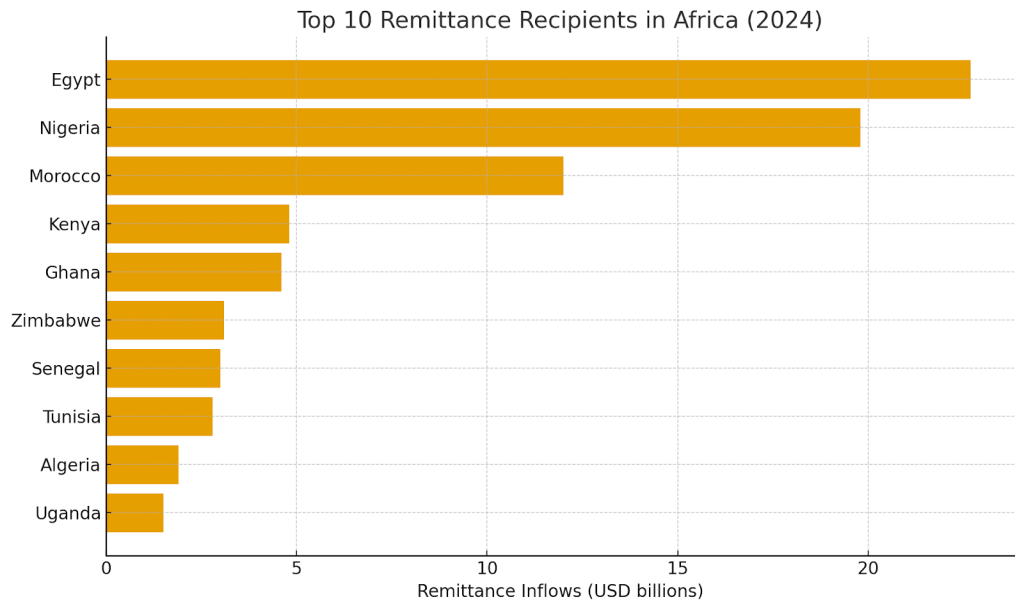
Source: World Bank estimates 2024
Ghana recorded $4.6 billion, driven by its steadily growing diaspora in Europe and North America. Countries like Zimbabwe ($3.1 billion), Senegal ($3.0 billion) and Tunisia ($2.8 billion) continue to depend heavily on overseas workers supporting parents, siblings and extended family networks. Even nations such as Algeria ($1.9 billion) and Uganda ($1.5 billion) reflect the deeply personal flows of support that sustain households across the continent.
These numbers are more than economic markers. They map the emotional labour of millions. They show where the weight of long-distance love is heaviest, where families lean most on sons and daughters who crossed oceans in search of a better quality of life. The money that reaches Lagos, Accra, Nairobi or Casablanca is rarely surplus income. It is earned through long shifts, shared rooms, skipped meals and the constant balancing act of surviving abroad while sustaining life at home.
In Nigeria’s nearly $20 billion, you can trace the hands of healthcare workers in London sending money after night shifts; tech workers in Berlin supporting siblings through university; and factory workers in Dubai paying rent for parents in Benin or Calabar. In Ghana’s $4.6 billion, you find the sacrifices of students in Toronto working two jobs, and families in New York pooling resources to keep a grandmother comfortable in Kumasi. Kenya’s $4.8 billion reflects the efforts of domestic workers in Saudi Arabia, drivers in Qatar, nurses in Minnesota and engineers in Melbourne — all linked by the same thread of obligation and affection.
These are not luxuries sent home; they are lifelines. In many countries, remittances fund daily survival: food, rent, hospital bills, school fees. They fill the gaps where public welfare is thin or absent. They protect families from slipping into poverty. They support entire communities. In some rural regions, diaspora money accounts for more household income than farming, local businesses or government programmes combined.
Yet beyond the economics, the numbers reveal where love stretches the farthest. They reflect the emotional geography of African migration, showing that even when people leave home physically, they rarely leave emotionally or financially. When we speak of remittances, we are really speaking about sacrifices: parents who miss childhoods but not school fees; lovers who cannot share a bed but can share a bank account; siblings who are absent at ceremonies but present in every emergency. These billions are the global footprints of intimate devotion. They prove that Africa’s greatest welfare system is its own diaspora, a system built on love, duty and the enduring belief that no matter how far one goes, home must remain standing.
In the countries where remittances flow the most, one pattern is clear. Migrants are the quiet pillars holding families together. The money travels through digital rails, but behind every transfer is a human being who is tired, determined, hopeful and deeply connected. The data is unmistakable. Where money flows, love follows across borders, carrying the weight of a continent’s dreams and the resilience of its people.
How love, obligation and sacrifice shape life across continents
The story of long-distance love is ultimately one of transformation. Migration changes people not only physically, but emotionally and economically. It teaches resilience, but also reveals vulnerability. For migrants, love becomes elastic. It stretches across airports, borders, screens and currency conversions. It becomes a negotiation between presence and absence, between who they are becoming abroad and who they used to be at home. This love is powerful, but complicated. Parents abroad raise children who know them mostly through screens. Couples navigate jealousy, time zone fatigue and long silences. Friendships fade. New ones are built. Migrants develop a dual identity—belonging partly to the country that raised them and partly to the country that now hosts them.
Yet in this complex dance, their sacrifices hold families together. Remittances become investments in hope. Financial support becomes a way of staying woven into the fabric of home. Even when migrants feel emotionally distant, their money maintains closeness that distance threatens to erode. The impact travels both ways. Families gain financial stability, but sometimes lose emotional intimacy. Partners feel supported, but sometimes abandoned. Children grow up grateful yet resentful of an absent parent. No one escapes unchanged.
Yet despite its difficulties, long-distance love reveals something beautiful: the extraordinary capacity of African families to stay connected, survive, adapt and love loudly, even when divided by continents. Migration is not simply about leaving. It is about sending pieces of oneself back home in every transfer, call and sacrifice. In a world where borders tighten and economies strain, the most consistent form of support African families have is one another. And in that truth lies the quiet power of long-distance love—a power built on sacrifice, sustained by technology, fuelled by devotion and defined by the unbreakable ties that distance cannot erase.
Writer:   Victor Ejechi
Editors:  Nafisa Mohammed, Amaka Obioji
Image:    Diaspora Africa