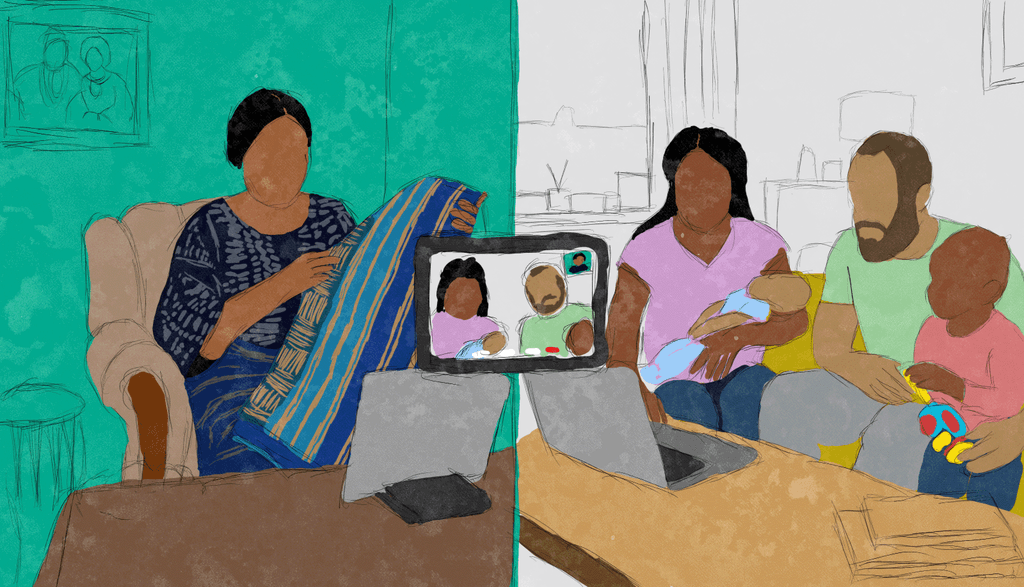



Moving back to Nairobi after a lifetime in the UK has a funny way of complicating the word “diaspora”. You imagine it as somewhere else — London, Minnesota, Dubai — until you notice how often it appears in ordinary life here: in school fees, hospital bills, family WhatsApps, exchange-rate conversations and government speeches about national development.
Across Africa, the diaspora conversation usually splits in two. Around the family table, they are about the daughter in London, the cousin in Minnesota, the uncle in Dubai — sacrifice, success, or maybe both. In policy circles, the language hardens into brain drain: doctors, nurses and engineers leaving faster than the country can train replacements.
Both conversations are true. Neither is the interesting one.
The more useful question is not simply why people leave, or whether leaving is good or bad. It is what leaving has quietly made possible. From Nairobi, the diaspora looks less like an external community sending help home than a working part of the economy: a mechanism through which households manage risk, foreign currency enters the country, and the state has learned to imagine resilience.
Kenya is not exceptional because it has a diaspora. It is useful because the pattern is unusually visible: remittances have become large, the state has become attentive, and the politics of destination countries has become less predictable. Versions of the same story are playing out from Nigeria to Ghana to Ethiopia, but Kenya lets us see the machinery clearly.
Steadier Than the Money Everyone Chases
The easiest mistake is to make this a story about remittances. It isn’t. Remittances are the evidence. According to the Central Bank of Kenya, annual diaspora remittances rose from roughly $338 million in 2004 to about $4.95 billion in 2024, and past $5 billion in 2025, a roughly fifteen-fold increase in two decades. Even accounting for changes in the value of money over those two decades, the scale of that growth remains striking.
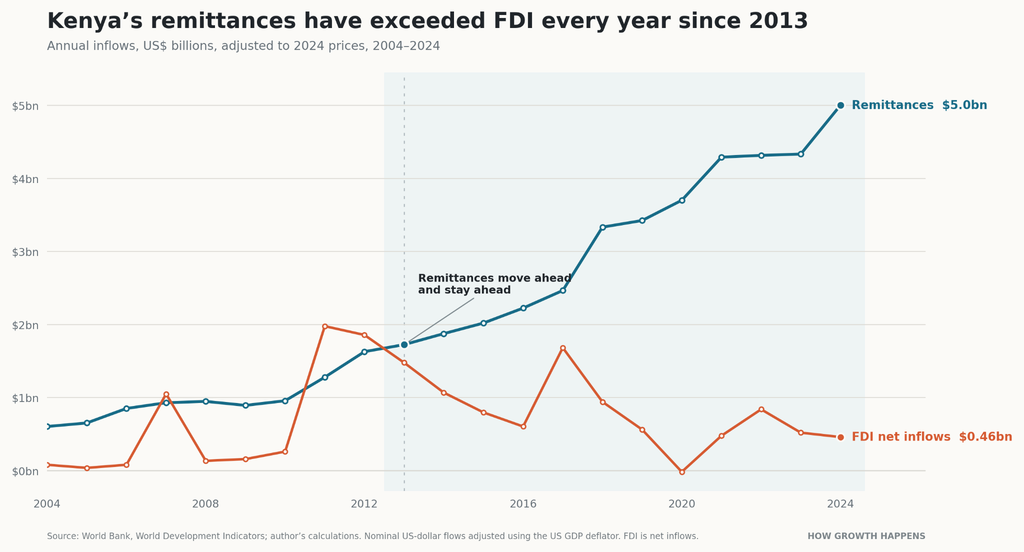
Set that against foreign direct investment: the factories, infrastructure projects and corporate expansion that presidents gleefully announce, investment agencies chase and newspapers treat as proof that an economy is open for business. The comparison sharpens quickly. Kenyan remittances have been larger and steadier than FDI net inflows for most of the past decade.
That doesn’t make them the same thing. FDI is investment capital; remittances are private transfers between people. But both bring foreign exchange into the economy, and only one gets treated as a development strategy. The other is still filed under family support, which is precisely the mistake.
When $7.2 Billion Becomes Household Insurance
Macroeconomics can make remittances sound abstract: foreign exchange, external inflows, balance of payments. The 2025 Remittances Household Survey, shows where those billions are ultimately allocated within the household budgets. Kenyan households received about US$7.2 billion in remittances between June 2024 and May 2025, nearly KSh1 trillion moving not through grand investment plans, but through family budgets.
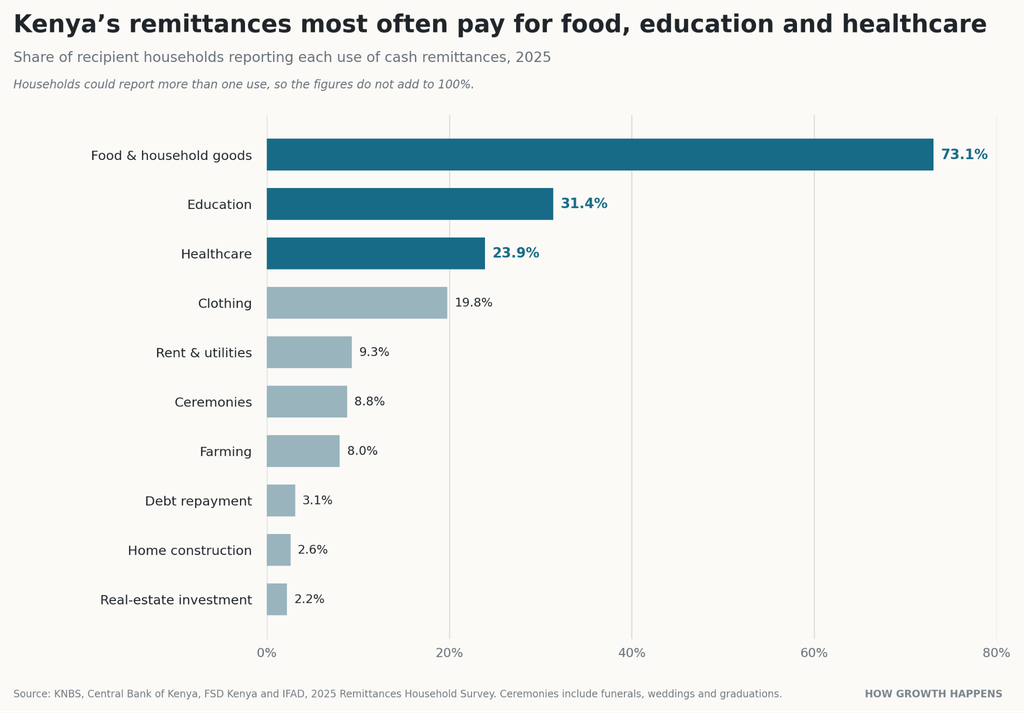
These billions were not floating abstractly through the economy; they were landing in shopping baskets, school accounts and medical bills.
But household resilience and economic transformation are not the same thing. Remittances can function as insurance paid from abroad, keeping families fed, children learning and patients treated. That is a powerful safety net, but it is not a growth formula: money dispersed across household budgets does not automatically finance factories or generate the next wave of formal employment.
Remittances can therefore stabilise families without transforming the economy’s productive structure. That is precisely why they matter. Their scale reveals both the strength of transnational family obligation and the weakness of domestic systems expected to provide security, employment and opportunity in the first place.
Courting What It Cannot Control
The Diaspora Policy 2024 frames savings, investment, remittances, technology transfer and international job placements as part of the national development agenda. Likewise, the Diaspora Growth Strategy turns that into a more practical programme: diaspora registration, investment facilitation, expanded employment opportunities, international job placement, remittance efficiency and stronger bilateral labour agreements.
However, Kenya does not control the labour markets that make this possible. That matters because African workers have become important to the very sectors that generate these flows. The UK’s health and care system is one example: the Home Office says the rise in Health and Care Worker visas after 2021 was driven partly by Sub-Saharan African nationals, including Zimbabweans, Ghanaians and Nigerians, coming to work as care workers.
Those routes are now much tighter: work visas began falling from late 2023, and Health and Care Worker visas for caring personal service occupations were down by more than 99% in the year to June 2026 compared with the December 2023 peak.
Nor is this only a British story: the OECD found that labour migration to member countries fell by 21% in 2024 compared with 2023, with declines in three-quarters of OECD countries after the post-Covid surge. The lesson is that migration politics in destination countries can quickly redraw the pathways African governments rely on.
That is the tension: African governments can prepare workers for jobs abroad, but they cannot decide whether destination countries keep the door open.
What the Brain-Drain Debate Misses
The brain-drain frame isn’t wrong to worry about this. Skilled emigration genuinely strains public services, health above all. It is wrong because it treats migration only as subtraction, when the evidence shows a circuit: labour leaves, money returns, households absorb shocks, a government learns to speak the language of diaspora investment. But a circuit is not a transformation. It is a way of coping with the absence of one.
From Insurance to Investment
None of this means Kenya has outsourced its development to citizens abroad. That would flatter the state’s intentions more than the evidence supports. The more accurate reading is that successive governments have learned to treat the diaspora as an economic asset partly because the domestic alternative (enough formal jobs, functioning public services, and a currency that does not need rescuing) has not arrived on schedule.
That’s the uncomfortable part. If remittances are filling gaps that a functioning domestic economy should be closing, then their growth is not proof that development is working. It is a record of what development has not yet done: now supported by an infrastructure that sits outside the country’s borders, and increasingly outside its control.
The harder question is whether Kenya, and African countries more broadly, can build economies strong enough for diaspora money to become investment, ambition and choice — rather than insurance against systems that still fail too many people.
Writer:  David Odhiambo
Editors: Chimee Adịọha, Amaka Obioji
Image:   Diaspora Africa