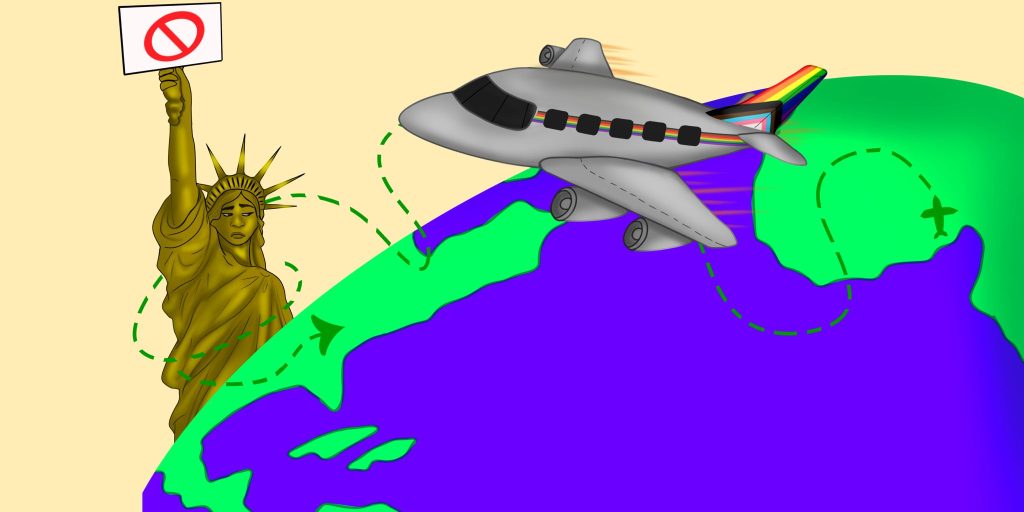

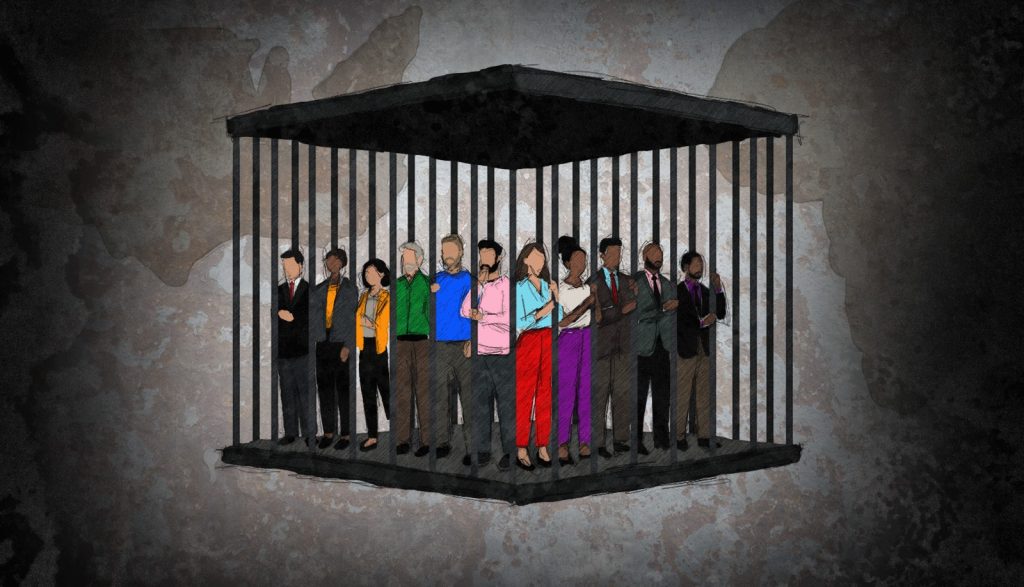
A network of Christian evangelical organisations has spent nearly two decades and tens of millions of dollars fueling a storm of anti-LGBTI+ legislation across Africa.1 That same network now drafts and bankrolls a parallel wave of anti-LGBTI legislation including anti-trans bills sweeping through American statehouses.2 Meanwhile, new and expanding U.S. immigration laws increasingly restrict access to refuge for endangered migrants and regularly return those who found safety back to the danger they fled. Together, these trends form a closed circuit of violence and oppression that prevents Black LGBTI+ migrants from finding safety, community, and home on either side of the Atlantic.
Africa’s Widening Net
In recent years, many African countries have criminalised same-sex relations for the first time; several others have revived dormant colonial-era statutes or expanded upon existing anti-LGBTI+ laws.3 Today, thirty-three African countries criminalise homosexuality.4 This rise is sharpest in West Africa: Mali, Burkina Faso, and Niger have each criminalised same-sex relations for the first time and, along with Senegal and Ghana, which now criminalise even the “promotion” of LGBTI+ identity.5
By contrast, non-criminalising countries cluster most heavily in Southern Africa,6 home to Namibia and Botswana, which, in the last two years, became the only two African countries to repeal their anti-LGBTI+ laws.7 It’s also home to South Africa, the country with the continent’s most meaningful LGBTI+ protections. Its Constitution explicitly bars discrimination based on sexual orientation, and a 2024 hate-crimes law also added formal protections for gender identity.8 Even there, stigma and harm persist, as hate crimes disproportionately target Black LGBTI+ South Africans.9
Uganda’s 2023 “Anti-Homosexuality Act” serves as a template for other nations building or expanding their own anti-LGBTI+ regimes, and it did not emerge from Ugandan politics alone. Several American evangelical groups spent years laying its groundwork: hosting conferences in Kampala, addressing Uganda’s Parliament directly, and framing LGBTI+ identity as a foreign threat to “family values.”10 The result is one of the world’s most severe anti-LGBTI+ regimes, imposing life imprisonment for same-sex activity; the death penalty for “aggravated homosexuality”; and up to twenty years’ imprisonment for supporting LGBTI+ people and organisations.11 This template of oppression has already found imitators. Kenya’s pending “Family Protection Bill” borrows its death penalty language directly and imposes a comparable ten-year minimum sentence for promoting LGBTI+ rights.12 Ghana’s “Human Sexual Rights and Family Values Bill” introduces a similar promotion ban and a duty to report LGBTI+ activity, encouraging citizens to surveil and denounce one another.13 In Senegal, a member of the ruling party declared that “Homosexuals will no longer breathe in [Senegal]” as parliament passed a law doubling the prison sentence for same-sex relations and criminalising LGBTI+ advocacy and “transsexuality”—extending the law beyond conduct to gender expression itself.14
None of this is incidental. The same evangelical network funding Uganda’s law is at work elsewhere, spreading anti-LGBTI+ rhetoric and influence far beyond Uganda’s borders.15 It is one coordinated campaign of hate, not thirty-three separate national stories.
America’s Parallel Turn
The U.S. is writing its own version of this same story of hate and exclusion. State legislatures introduced more than 600 anti-LGBTI+ bills in 2025 alone, up from roughly 500 in 2024.16 At least seventy are now law, and twenty-nine states have adopted at least one of four common restrictions: limits on gender-affirming care, bans on transgender athletes, bathroom laws, or rules against using a person’s chosen name or pronouns.17
A new wave of anti-LGBTI+ legislation—so-called “sex-definition” statutes—goes further still, fixing a person’s legal sex at birth and applying that definition across all of state government, reaching far beyond earlier laws’ narrower targets. For example: Kansas’s S.B. 244 invalidates and reissues any driver’s license or birth certificate that doesn’t match a person’s sex at birth, mandates that public bathrooms be sex-segregated, and writes a single biological definition of sex into every Kansas statute.18 At least thirteen states have passed some version of this legislation, most modelled on the language from a single conservative advocacy group.19 Some adopt the model wholesale; others borrow only pieces or construct similar provisions. That range, from loose imitation to full adoption, mirrors the trend of copycat laws now spreading across Africa.
This legislation concentrates most heavily in the South. Texas alone accounts for 100 of the anti-LGBTI+ bills introduced in 2025.20 Crucially, the South is also where a plurality (44%) of Black immigrants live in the U.S., and where more transgender Americans live than in any other region.21 That overlap is dangerous—the people these laws target live disproportionately where the laws are harshest. For Black LGBTI+ migrants, persecution does not end at the border; it simply continues in a new form, in the U.S. states they now call home.
Closing the Door
As African and U.S. states grow more dangerous for Black LGBTI+ migrants, U.S. immigration law compounds that threat, narrowing their pathways for escape while expanding legal mechanisms to return them to persecution or dangerous “third-countries.”
These barriers begin before anyone leaves home. A federal Travel Ban that suspends entry for nationals of certain countries disproportionately targets African nations. Of the 39 officially “banned” countries, plus individuals travelling on Palestinian Authority-issued documents, twenty-six (66%) are African, despite Africa holding only 28% of the world’s nations.22 Haiti and Dominica, both majority-Black nations, are on the list too.23 The pattern is racial: Black immigrants, primarily from Africa and the Caribbean, are only 11.2% of all U.S. immigrants,24 and yet they bear the brunt of the travel bans.
Other laws further close routes into the U.S. In June 2026, the Supreme Court reinstated “metering”, a policy permitting border officials to block and turn away migrants at the border, even if they request asylum.25 That discretion won’t be applied evenly; Black migrants face documented, disproportionate mistreatment in immigration enforcement.26 The disparity is no accident—recent changes to refugee admissions make the intent explicit. In October 2025, the administration set the FY2026 refugee cap at 7,500—the lowest in the program’s 45-year history and a fraction of the 92,000-person average—with admissions primarily reserved for white Afrikaners.27 In May 2026, it added another 10,000 slots reserved entirely for Afrikaners.28 Only three refugees admitted all year have come from any other country.29 The door to refuge is not being closed on every endangered person; it is slamming shut on Black migrants while being held open for white ones.
These barriers don’t end once someone is inside the U.S. Under Asylum Cooperative Agreements (ACAs)—bilateral deals permitting the U.S. to deport asylum-seekers to third countries they have no connection to without a hearing—the administration has sent roughly 22,000 people to at least 26 countries and dismissed nearly 30,700 asylum applications without ever hearing their claim.30 Where someone ends up is arbitrary and often dangerous. Many ACA countries criminalise homosexuality outright31; others are marked by documented anti-Black violence and discrimination32; and some carry both risks at once. Thus, a Black LGBTI+ migrant’s case can be dismissed on a technicality and rerouted directly into the harms the asylum system exists to prevent. Even citizenship offers no permanent floor: denaturalisation cases have gone from under 150 total across 45 years to a quota of 100-200 a month, with no statute of limitations.33
States in the US have also begun regulating immigration themselves, despite it being a domain the Constitution reserves for the federal government.34 As in Africa, one state’s law has already become the template others copy. Texas’s S.B. 4, in effect since May 2026, lets local police arrest and prosecute anyone suspected of entering the U.S. illegally, and lets state judges order their removal, all without federal involvement.35 At least five states—Georgia, Iowa, Louisiana, Oklahoma, and Tennessee—have already passed close copies of this law.36 Critically, these laws cluster in the South—the same region already carrying the country’s strongest anti-LGBTI+ laws and its largest Black immigrant population.
At nearly every stage of the immigration process, the process also demands the immigrant prove the exact thing that makes them a target: be it by a passport marked with a sex they no longer live as or an asylum claim built on being gay or trans in a country that required them to hide who they were. For Black LGBTI+ migrants, the paperwork meant to establish who they are and why they need refuge becomes the paperwork most likely to expose them if it is ultimately denied.
Tsion Gurmu (she/her/እሷ)) is an Ethiopian-American attorney, futurist, writer, and researcher on migration, with special focus on gender and sexuality. Tsion is the Legal Director of the Black Alliance for Just Immigration (BAJI).

Nekessa Opoti (she/her) is a communications strategist whose work articulates and amplifies the stories of Black people living at the intersections of migration, gender, class, and sexuality. She is the Communications Director of the Black Alliance for Just Immigration (BAJI).

Jason Mosebach (he/him) is a 2L at The George Washington University Law School, where his studies focus on immigration and international humanitarian law. Jason also serves as a Dean's Fellow. After law school, he plans to pursue a career in public interest.