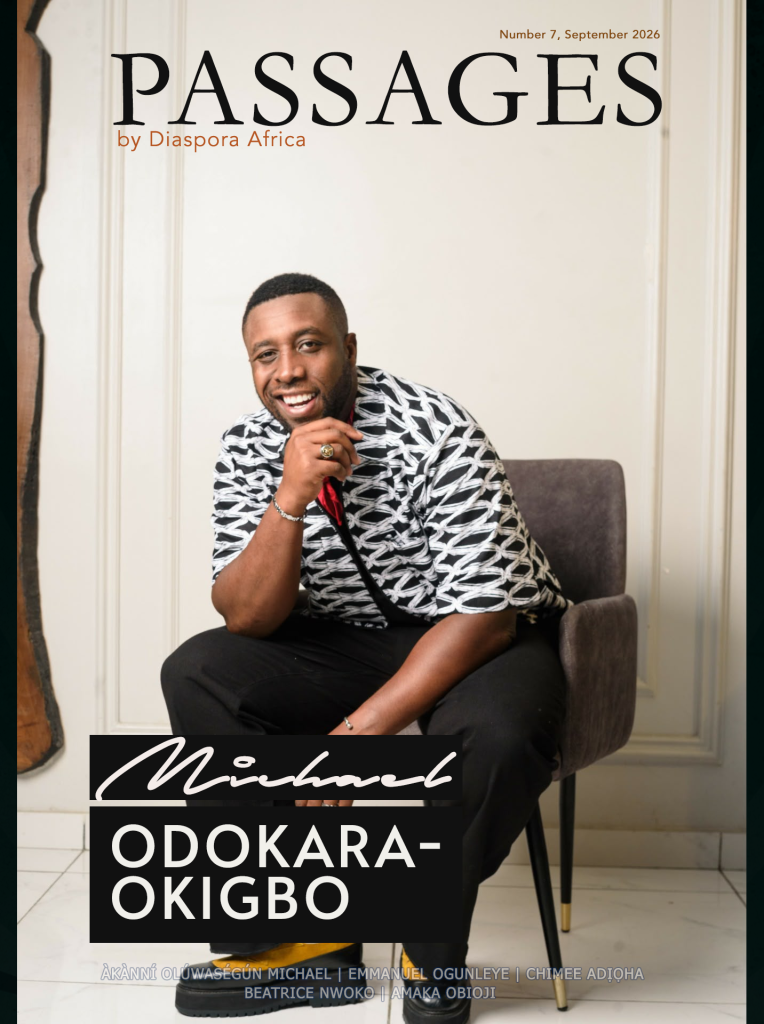
Michael Odokara-Okigbo was born in the United States, built a career across continents, and named his most ambitious project after his mother. NKENNE, the language-learning app he founded, is quietly becoming one of the most important cultural infrastructure projects in the African diaspora.
There is a particular inheritance that many children of African immigrants receive in silence. Not the inheritance of land or money, but of language, half-given, half-withheld, arriving in fragments through kitchen conversations, phone calls to relatives in another time zone, prayers offered in a tongue the children heard but never fully entered. For Michael Odokara-Okigbo, that inheritance was Nigerian. And the distance between receiving it emotionally and accessing it linguistically became, over the years, the very problem he decided to build a solution for.
NKENNE, the platform he founded, focuses on teaching African languages alongside the cultural contexts that shape how they are spoken and understood. Rather than limiting lessons to vocabulary or grammar rules, the app incorporates elements such as greetings, family address, and the subtle ways respect is expressed in everyday speech. “We believe language should not be taught in isolation,” Odokara-Okigbo says, “because culture gives language its meaning.”
“For many people in the diaspora, the connection to Africa is already there emotionally, they may know the food, the music, the family stories, the names, and the traditions, but they may not have had the tools to fully enter the language. That is where my intervention comes in,” he says.
NKENNE is named after Michael’s mother, a single mother. She worked, as her son describes it, day and night, building a life in America that would give her children access to the kind of opportunities that migration is supposed to promise. Her steadfastness is the reason Michael Odokara-Okigbo attended Dartmouth College.
That personal foundation shapes the entire philosophy of the platform. While other language apps are built around gamification and efficiency, NKENNE is built around something harder to commodify: belonging. The goal is not fluency as a performance metric. The goal is the return, the feeling, however gradual, of finding your way back to yourself.
“My mother always says, ‘You have to know where you come from to know where you are going.’ NKENNE was built in that spirit.”
NKENNE currently offers lessons in several African languages, including Swahili, and continues to expand its offerings. But the question of how to teach African languages responsibly, not just correctly, is one Odokara-Okigbo takes seriously.
For too long, major technology platforms have treated African languages as afterthoughts, added them late, stripped them of context, and reduced them to utility. The result is that hundreds of millions of Africans have found their languages poorly represented, or not represented at all, in the digital tools that increasingly mediate daily life.
As artificial intelligence reshapes global communication, the languages best represented in training data will have the most presence in that future. Languages with little data risk are being left further behind, not just culturally marginalised, but technologically erased.
“The consumer app helps people learn,” Odokara-Okigbo explains. “NKENNEAi helps ensure African languages are not erased from the future of AI.”
The question of which languages to prioritise is one he approaches with deliberate care. With over 500 languages in Nigeria alone and thousands across the continent, no startup can build everything at once. NKENNE uses user demand, community requests, market research, and educator availability to guide its roadmap. But Odokara-Okigbo is clear that the authority to define which languages matter lies with the communities that speak them, not with the platform.
“I would not describe our work as deciding which languages are ‘official enough’; communities carry that authority. Speakers carry that authority. Our role is to build responsibly and listen carefully,” he said.
In practice, NKENNE uses user demand, community requests, educator availability, and existing data to guide its roadmap while acknowledging that smaller languages, often the most endangered, are not less important but more urgent.
The Kenyan writer Ngũgĩ wa Thiong’o argued in Decolonising the Mind that language is the collective memory bank of a people and that when colonialism strips a community of its language, it strips something deeper than vocabulary. It disrupts the inner architecture through which people understand themselves, their history, and their relationship to the cosmos.
Odokara-Okigbo does not dispute this. But he does not accept that the memory is gone. “Our languages are still with us. They are in our names, our families, our music, our food, our prayers, our greetings, and our stories. The work now is to bring them forward with intention.”
This is also how he speaks to diaspora parents who carry guilt about not teaching their children their mother tongue, parents who prioritised assimilation or survival, or simply the pressures of building a new life in an unfamiliar country.
“I do not think those parents failed,” he says. “I think many parents were making the best choices they could with the circumstances in front of them. Heritage is not gone just because you did not learn it at age five. Language, culture, and identity can still be reclaimed.”
NKENNE is not in the business of blame. It is in the business of return, and in Odokara-Okigbo’s vision, that return is available to anyone, at any age, from anywhere on the map.
This is what distinguishes Odokara-Okigbo’s project from a work of preservation alone. Preservation implies something fragile, something you must protect from the elements. What he is describing is something more active, a reclamation, a reconfiguration, a decision made by a generation that still has the memory and is choosing, deliberately, what to do with it.
“We still have the language. We still have the culture. We still have the memory,” he says. “Now our generation has to decide how boldly we will carry it forward.”
Writer:  Àkànní Olúwaségún Michael
Editors: Chimee Adịọha, Amaka Obioji, Beatrice Nwoko
Design:  Emmanuel Ogunleye