

Introduction
With the outbreak of war in Sudan on April 15, 2023, between the Sudanese Army and the Rapid Support Forces, the country entered a dark tunnel of violence and destruction, leading to the world’s worst displacement crisis. According to UN reports, the human cost is estimated at approximately 150,000 killed, more than 25 million facing the risk of hunger and in need of urgent humanitarian assistance, 1.3 million children living in areas suffering from famine, and more than 14 million people forced to flee their homes, with nearly 11.1 million internally displaced. In contrast, more than 2.9 million people fled to neighbouring countries. Among these countries, the Republic of Chad stands out as one of the main destinations, hosting over 844,000 Sudanese refugees. Chad was already hosting approximately 409,000 Sudanese who had fled previous waves of conflict in Darfur. The UNHCR coordinator in Chad stated that about 239,000 refugees are still stranded at the border, exposed to weather fluctuations, insecurity, and the risk of further violence.
The Sudanese refugees in Chad represent a demographic mix that reflects the devastating and uneven impacts of the war on different groups. The approximate distribution can be detailed as follows:
- Women and girls are the most affected group. Women and girls together constitute the largest proportion, their share reaching about 58% of the total number of refugees.
- Adult women represent approximately 26%. Girls (under 18 years): Represent about 32%.
- Children (both males and females) under the age of 18 collectively constitute approximately 55% of the total refugees. This massive percentage clearly shows how childhood is bearing the heaviest burden of this humanitarian crisis.
- Men and Boys: Their proportion is only about 12%. This strikingly low percentage reflects a tragic reality that many men are either engaged in fighting, losing their lives in it, staying in Sudan to defend lands and property, or choosing more dangerous asylum routes to Europe. Boys (under 18 years): Their proportion is about 23%.
Chad: The Compelled Choice
The choice of Chad was not coincidental, but rather the result of several compelling factors. Chad is located on the western border of Sudan, specifically with the Darfur region, which has a long history of conflict. This geographical proximity made it the fastest and closest refuge for civilians fleeing the scourges of bombardment and violence. In addition, the interwoven tribal and cultural ties between the populations in the border areas of both countries facilitated the asylum process, compared to other options that require greater financial resources and complex entry visas, as is the case in Egypt.
The journey itself is a trauma. Israa, a 23-year-old university student who fled from the Morni area, located about 83 kilometres south of El Geneina city, to Chad, describes the journey as exhausting: “The journey to Chad was arduous. After our relatives offered to get us out and sent a car to pick us up, we didn’t know what would happen to us. The road was perilous. “For others, like Susan, a 32-year-old mother and former teacher, says the escape was pure horror: “The journey was very frightening, moving from one country to another for the first time because of war and insecurity. There were corpses in the streets; it was indescribable terror. It’s normal for a person to be killed in the street because of their ethnic affiliation, or for your child or your family to be killed, and you can’t save your loved ones.”
An Escalating Influx
Chad has witnessed successive waves of displacement with the escalation of the war in Sudan. These numbers have increased significantly with the expansion of military operations and the imposition of a suffocating siege on main Darfur cities such as El Fasher and other cities. This siege, which prevents the arrival of humanitarian aid and food and prevents civilians from fleeing safely, has pushed thousands to leave their homes on perilous journeys through conflict areas on foot or on the backs of animals, seeking a safe haven across the border in Chad, only to be met with a harsh reality.
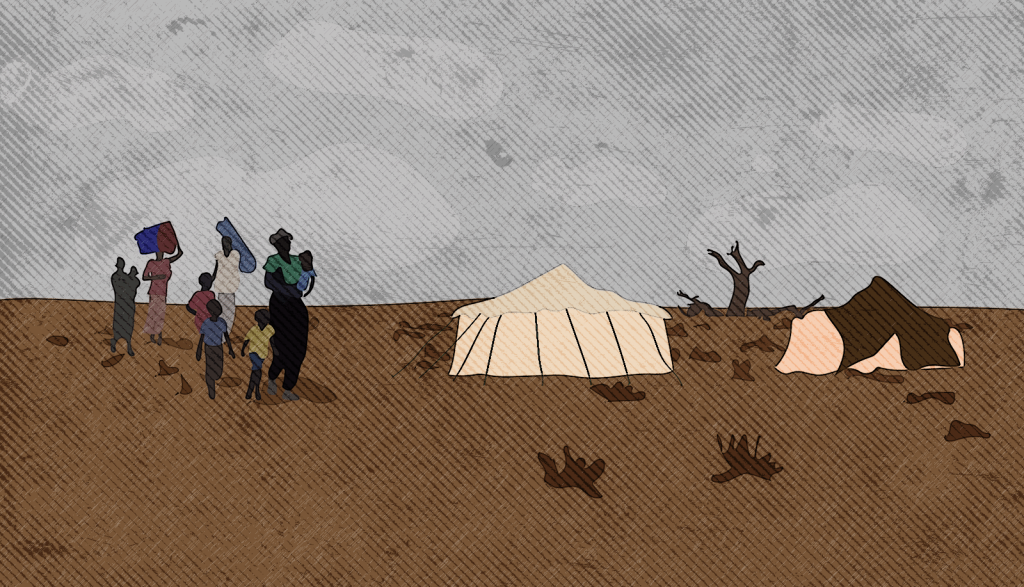
Sudanese refugees are primarily concentrated in six camps: Al-Malik, Mije, Abu Tinein, Abu Tinqouri, Hajjar Hadid, and other camps. These camps are nothing but worn-out tents spread across arid areas, suffering from a severe lack of the most basic necessities. Basic services are almost non-existent, as the camps suffer from a severe shortage of clean drinking water and sanitation facilities, threatening the spread of epidemics and diseases. Healthcare services are almost non-existent, especially for those with chronic illnesses and pregnant women. A food crisis threatening with famine: Families rely entirely on international food aid, which does not arrive regularly or sufficiently. Deaths due to malnutrition have been recorded among children and the elderly.
Overcrowding in these camps exacerbates social problems and increases the risks of violence, especially against women and girls who are exposed to the risk of sexual exploitation. The life these refugees were forced to leave behind stands in stark contrast to their current reality. Before the war, they were building their futures. Susan remembers a life of stability and community: “We were settled, employed, and our children studied in the best schools. Our time was organised; we had shifts at institutes to improve our English. Our children and family were around us, happy. We used to go out on holidays and attend family weddings. Our community had strong relationships. Our life was comfortable, with electricity, water, and an affordable internet.”
Their cherished memories are woven into the social and natural fabric of Sudan. Israa speaks of her large, loving family gatherings and nights of companionship, deeply missing her loved ones and neighbours. Susan longs for the “valleys and green trees,” trips with her sisters, and national celebrations like Independence Day and the announcement of high school results.
Compounded Challenges and an Inadequate International Response
For Susan, the devastation is equally profound: “The war affected my psyche and my future; it destroyed all my ambitions. My life has become dark because I cannot study, as I don’t have the money for it. Even handicrafts in the market are not viable. In a refuge, food and drink are the only priority.”
For Sudanese refugees, Chad is not just a different country; it is a different world, a world where hope struggles to survive. Israa feels this disconnect acutely: “Chad is different from Sudan in all aspects of life; there is no similarity between them. My ambitions are tied to Sudan. Life in Chad is difficult, and there is no solidarity.”
Susan points to the lack of opportunities, describing Chad as “a backward country in terms of education and progress. There aren’t even job opportunities, so we suffer immensely.”Chad, one of the world’s poorest countries, faces enormous pressure on its already fragile infrastructure and limited resources. Only a few humanitarian organisations operate in these camps, leading to concentrated efforts in some areas and neglect in others, creating a state of “competition” among refugees for scarce resources. The war not only displaced people but also killed their aspirations.
Israa’s academic ambitions were shattered, leaving her in a state of existential despair: “The war affected my ambitions. I cannot continue my studies. I am just a person who ‘eats, sleeps, and wakes up.’ Others are achieving accomplishments, people are moving forward with their lives, and I am just not studying; I miss that.”
Chad has transformed from a safe haven into the scene of one of the world’s largest humanitarian disasters. Sudanese refugees there live in inhumane conditions, trapped between the hell of war in their homeland and the hell of scarcity and despair in the land of refuge. This crisis calls for urgent and expanded international action to provide protection and life-saving humanitarian assistance, and to pressure the conflict parties in Sudan for a ceasefire and to open safe corridors. The future of hundreds of thousands of innocents hangs in the balance between the world’s rescue and its silence.
One Final Wish: to Return Home
When asked about their biggest wish, the answer is unanimous and heartfelt. Despite everything, their hope is tied not to a new life abroad, but to the home they were forced to leave. Israa’s wish is simple: “To return to Sudan and for life to return to how it was before the war, with my people, even though I have lost many.”Susan echoes this longing: “My wish is for the war to end, for peace, security, and stability to come, and for us to return to Sudan.”
Writer:   Abla Salih Boush
Editors:  Amaka Obioji, Chimee Adịọha
Image:    Diaspora Africa