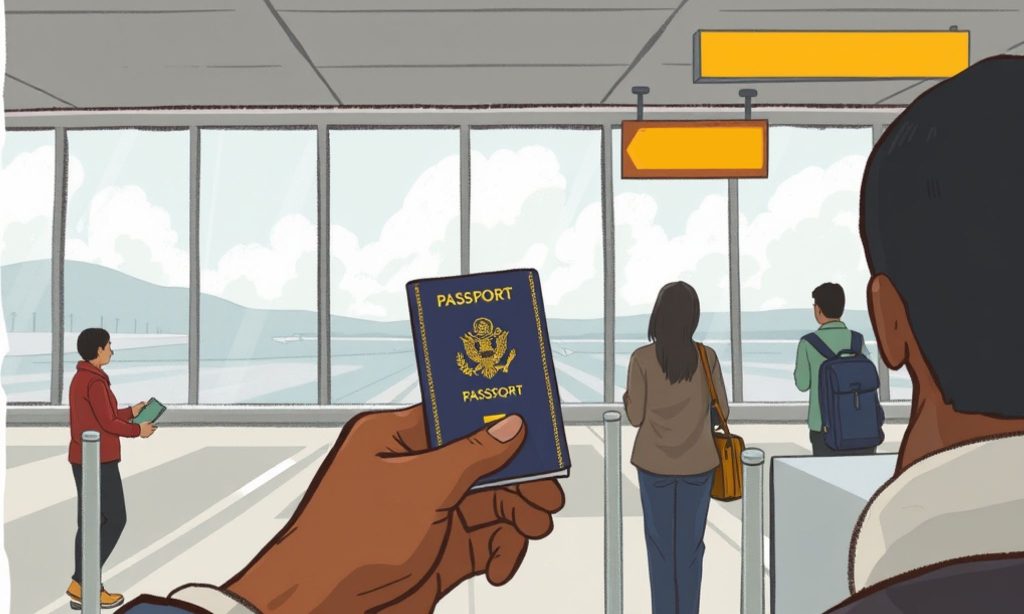



Every year, the United States welcomes tens of millions of international travellers, making it one of the most visited countries in the world. Within that bustle, however, lies a quieter concern in U.S. immigration policy about what happens after entry. While visa systems are designed to screen applicants before arrival, authorities also track compliance among those admitted on temporary visas—particularly B1/B2 visitors travelling for business and tourism. And at the heart of this concern is the issue of visa overstays.
According to the U.S. Department of Homeland Security, hundreds of thousands of nonimmigrant visitors remain in the country beyond their authorised period of stay each year. It is that pattern they say influenced its recent visa bond policy.
Implemented as a 12-month pilot, the visa bond policy applies selectively to nationals of designated countries. Applicants for short-term U.S. visas (B1/B2) are required to deposit between $5,000 and $15,000 as a bond, refundable only if they comply with the terms of their stay, including departing within the authorised period.
Africa in the Visa Bond Regime
Of the fifty countries captured currently in the program, thirty are African, including countries like Nigeria, Tunisia, Ethiopia, Zambia, and beyond.
But looking closely, that African concentration sits unfairly against the scale of global travel into the U.S. and its overall contribution to the overstay problem. In 2024, for instance, while the country recorded more than 70 million international arrivals, African countries, by contrast, contributed only a few hundred thousand of that volume. This is consistent with long-standing patterns in U.S. travel data, where Africa accounts for a relatively small share of total arrivals compared to regions such as Europe and the Americas, despite its far larger population size.
Within overstay data, the numbers are very revealing.
The visa bond is applied based on overstay rates, a metric that measures the percentage of visa holders from a given country who remain in the United States beyond their authorised stay. Under this approach, countries with higher proportions of overstays are more likely to be flagged for additional restrictions, regardless of how many travellers they send overall.
A report by the U.S. Congress notes that countries with the highest overstay rates often record fewer than 2,000 overstays annually, while countries with far larger travel flows account for the majority of total overstays.
Similarly, a recent Center for Global Development analysis found that for Burundi, Chad, the Republic of Congo, Equatorial Guinea, Togo and Turkmenistan, high overstay rates were the only reason cited for visa restrictions, even though those six countries together accounted for just 1,953 overstays in 2023 out of 565,154 nationwide—only 0.3 percent of the total.
Consequently, this pattern raises question about how risk is defined and applied. When policy is anchored to percentages rather than absolute numbers, countries with relatively few travellers can be classified as high-risk, while larger travel corridors, where the bulk of overstays occur, remain less affected.
Pricing Movement, Reshaping Migration
When the United States announced the visa bond back in August 2025, Zambia was among the first countries to push back, warning that the measure would place an “unnecessary financial strain” on its citizens. Officials pointed to the stark mismatch between the bond amounts and local economic realities, noting that the required sums far exceed what many Zambians earn in months.
That economic reality extends beyond Zambia. For many African applicants, especially those travelling for conferences, family visits or small-scale business, the process of acquiring a visa becomes more expensive and even harder to attempt at all.
By attaching a financial requirement to each trip, the policy makes movement harder to attempt or sustain, even. Travellers who might have visited once or twice a year may cut back or stop altogether. For families, this means longer gaps between visits. For professionals, it means fewer business trips or conferences. As a result, the measure risks dividing mobility into a two-tier system, where credibility includes the ability to absorb financial risk.
There is also the question of perception even for those who can afford it. Because the bond introduces uncertainty into the process, applicants are taking on the risk of delayed refunds, administrative complications or, in some cases, forfeiture. Research has frequently shown that uncertainty plays a significant role in migration decisions and can largely influence travel decisions.
At the same time, additional requirements such as financial verification and bond processing can increase administrative burdens on consulates, contributing to slower visa processing.
Toward a Fairer Mobility Framework
The introduction of the U.S. visa bond raises broader questions about how global mobility is regulated and who bears the cost of enforcement. While the policy is framed around compliance and overstays, its practical effect is to embed financial capacity more deeply into the conditions for movement. This risks reinforcing an already uneven global visa system in which travellers from certain regions face higher thresholds of scrutiny, cost, and uncertainty before they can move.
Although introduced as a 12-month pilot, leaving room for review, revision or discontinuation, its immediate effects already signal a shift in how mobility risk is being managed.
For African states, the challenge is not only to respond to individual measures like the bond, but to engage more systematically with the broader architecture of mobility governance. This includes strengthening diplomatic engagement on visa reciprocity, and also building coordinated regional positions that recognise how financial requirements increasingly function as a filter on movement. In doing so, African governments are better positioned to contest frameworks that treat mobility risk as a function of nationality rather than evidence at the individual level.
At the same time, regional bodies within the continent could play a more assertive role in articulating mobility as a development issue, not only a security concern. Just as trade and investment regimes are negotiated collectively, mobility regimes may also require more coordinated African responses where restrictive measures produce continent-wide effects on education, business exchange, and diaspora connectivity.
Ultimately, the central question for Africa should be how it could shape a future in which mobility is governed by transparent, proportionate criteria that do not convert economic inequality into travel restriction.
Writer:         Prosper Ishaya
Editors:        Amaka Obioji, Chimee Adịọha
Illustration:   Rukiya Mwangi/Diaspora Africa