

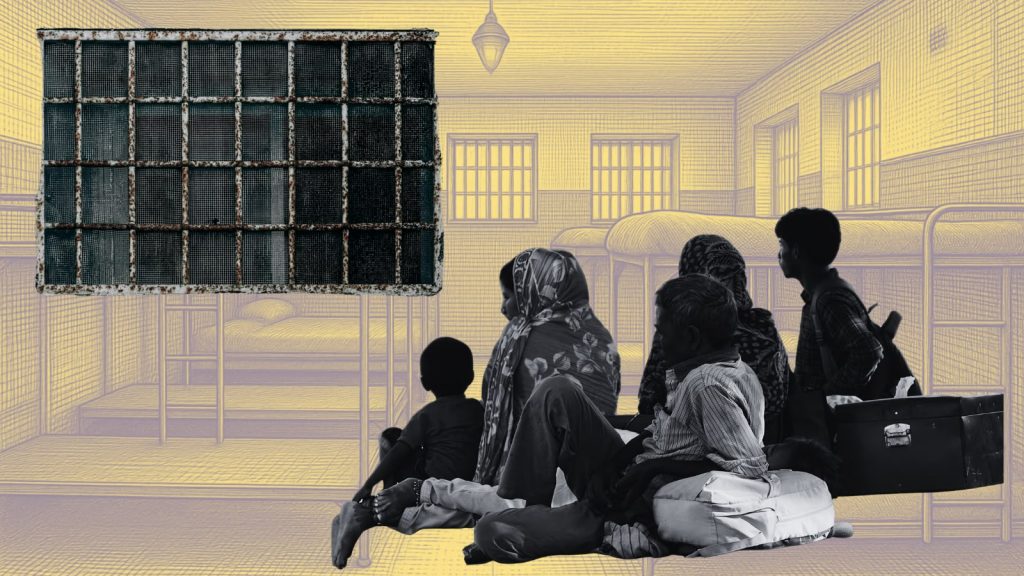
Ibrahim no longer remembers what life looks like on the other side of the fence. For almost a year he has woken in the same place, slept among dozens of other detainees, waited for a meal he wasn’t sure would fill him, and counted days without knowing which one could be the last.Ibrahim* is 39, Egyptian, a father from Assiut, south of Cairo, and he shares a cramped, stinking room he says is full of insects and snakes. He had just survived the sea crossing from Libya. He did not expect to spend the next year watching the men around him give up.
The Sintiki centre sits in Serres, northern Greece, near the Bulgarian border. It began as a facility to temporarily receive asylum seekers. In July 2025, it became a closed detention centre, part of Greece’s hardening response to arrivals by sea from North Africa.
By August of 2026, Greek media reported that between 400 and 500 people were held inside, the majority of them Egyptians, and approaching a full year in detention. Most are irregular migrants carrying deportation orders issued after their asylum claims were refused.
A Year That Never Ends
Hundreds of Egyptians set out on illegal sea journeys, travelling from Libya to Greece in search of work and a better economic life. But strict laws deny them residency. Yet, the Egyptians keep coming. On Wednesday,16 September, Egypt’s Foreign Ministry announced that a boat carrying irregular migrants had sunk off the Greek coast, with people of several nationalities on board, including Egyptians.
Ibrahim arrived with 83 other people on a single boat. They carried a version of Europe in their heads that didn’t survive contact with the place. “We were living on the hope of reaching Europe, the way we pictured it,” he says. “It turned out to be only a picture.”
Nobody in Sintiki can tell you when this ends. Most of them now want to go back to Egypt at any price. As Ibrahim describes it, life inside is the life of people stuck somewhere with no departure date. The food is inedible. Detainees clean up after themselves. Seeing a doctor can take days. In winter, some men sleep outside.
Detainees collected the rubbish and scrubbed the toilets themselves, Ibrahim told Diaspora Africa.
The men are packed into rooms with no air conditioning in summer. They are now heading into winter with clothing that, he says, will not keep them warm. “They gave us women’s clothes, worn-out clothes, clothes in terrible condition.”
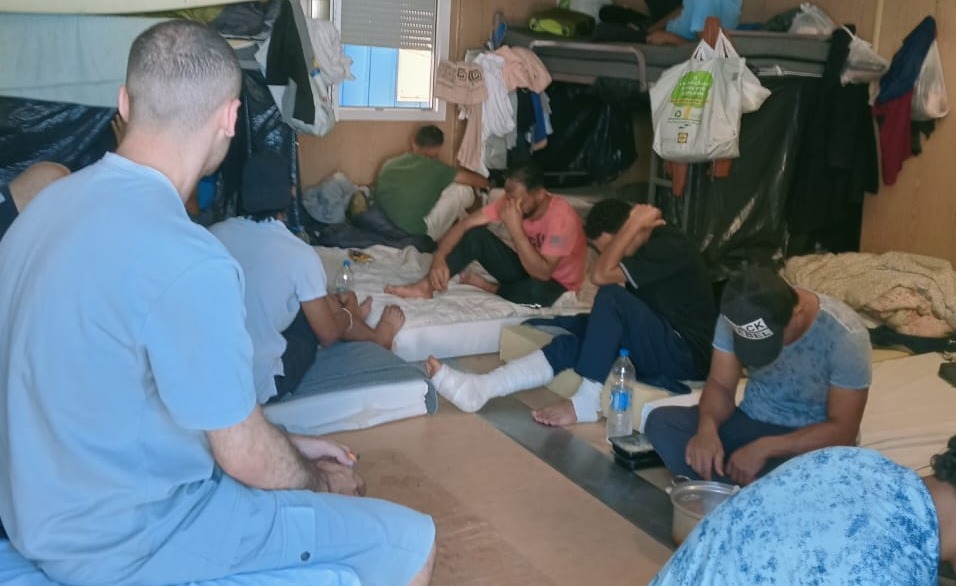
Men sit and sleep on mattresses laid directly on a floor covered with flattened cardboard. Personal belongings, plastic bags and clothes hang off the edges of the bunks. Black fabric hangs as a makeshift curtain—the only privacy available. Plastic water bottles and basic cooking pots are scattered across the floor.
Some of the men have stopped waiting. Egyptian detainees told Diaspora Africa that a number of them have tried to get out through the wire, and that a few made it before the authorities brought them back. They also describe self-harm and suicide attempts inside the centre. Two attempts occurred just last week. One Egyptian man tried to hang himself, but survived the fall and broke his neck. The psychological pressure has reached the point where some detainees can only sleep with the help of sleeping pills, according to Egyptians we spoke to inside Sintiki.
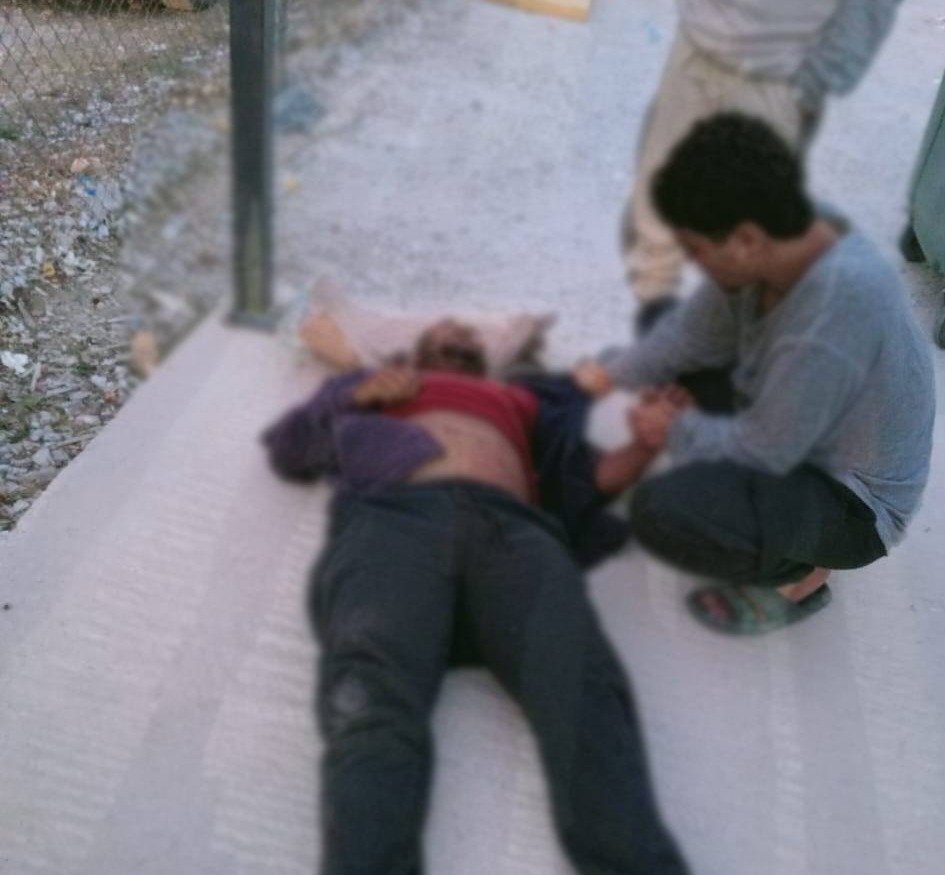
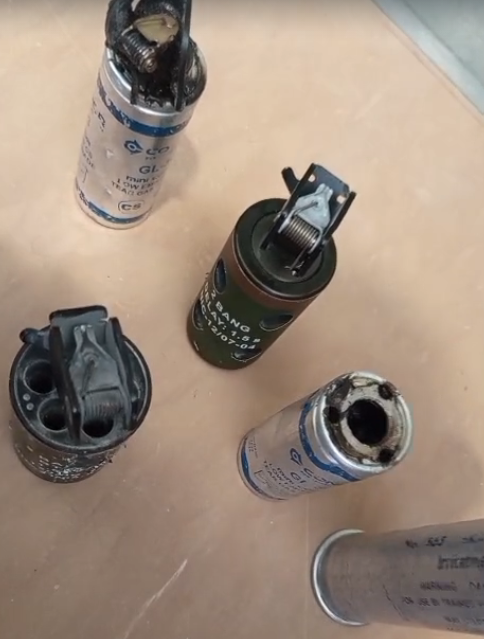
When detainees protested recently over the shortage of food, the state of the toilets and the sheer length of their detention, Greek officials answered by throwing stun grenades inside the facility. Greek police arrested 23 people, according to a statement.
Ayman, another Egyptian, 25, who also travelled to Greece by sea through Libya, says they sleep in tents through the cold and some sleep on the ground. Detainees went on hunger strike after guards took away their meals and threw them in the bin, he says. Others went four days without eating. Ayman told Diaspora Africa that the burgers are close to meatless, and the chicken sometimes arrives blue and smeared with blood. Even washing is not a routine act but another piece of hard labour. “We’re treated like dogs, not like human beings.”
“We Saw Death At Sea”
More than 300 Egyptian detainees put their situation in writing and sent it to KEERFA, a Greek anti-racist movement. They described more than a year of detention in conditions they said had drained them physically and mentally.
“Our children in Egypt have nothing to eat, and here we live like dead men. We are men, but we cry like children.”, they wrote.
The letter continues: “We saw death at sea, and then we found ourselves living humiliation and oppression inside Sintiki, without enough clothes, without food, without a dignified life. We are exhausted physically, psychologically and as human beings, and many of us have started thinking about ending our lives. All we did was dream of Europe and love it.”
Stella Nanou, communications officer at the UNHCR office in Greece, says the agency’s most recent visit to Sintiki in August found living conditions still difficult, with ongoing problems with hygiene, food quality, the provision of basic needs, and access to legal aid and information.
Speaking to Diaspora Africa, Nanou said the agency is concerned by how long people are being held. A number of detainees, she said, showed acute distress over the uncertainty of their status, the length of their detention and the conditions they are living in. UNHCR continues to work with the Greek authorities to push for adequate conditions and standards for the people held there.
According to UNHCR, Sintiki runs on a hybrid model, with an open wing for asylum seekers and a closed wing for administrative detention. The closed side mainly holds people whose asylum claims have been rejected. The agency says this dual use creates problems, because the infrastructure was never designed to serve reception and detention at the same time.
The Greek migration ministry did not respond to emailed requests for comment. The minister told reporters that about 300 people at the Sintiki detention centre have had their asylum claims turned down and are still being held while they wait to be sent back. After the recent unrest, some of them will be moved to other facilities.
The Serres Police Officers Union has raised the alarm repeatedly. Its president, Ioannis Kounios, said tensions have been building since May, partly because migrants are being held for so long. Some have been in detention for over a year, in conditions he said are not fit for long-term stays.
In September 2025, Greece raised the maximum period of administrative detention for migrants facing deportation from 18 months to 24, under new legislation tightening the rules on migration and removal.
Spyros Apergis, a senior lawyer specialising in asylum and migration, told Diaspora Africa that the extension of the maximum detention period is expected to be adopted in the autumn, alongside provisions to create return centres outside the European Union. It is a very long time to keep someone in administrative detention, he said, adding that detention is only lawful while deportation remains a real possibility. Once that’s no longer the case, he argued, the detention has to end. He also stressed that the migrant’s home country needs to cooperate. “Otherwise, deportation simply won’t happen.”
Out Of Detention, Into Limbo
For Egyptians in Greece, the difficulty does not stop at the “Sintiki”. Those who avoid detention face a different fight, which is staying in a country that treats them as illegal residents rather than as people seeking protection.
In an Athens metro station, Greek police stopped Mahmoud, a 22-year-old Egyptian, and discovered his asylum application had been suspended. In a moment, he went from protection seeker to illegal resident facing prison under Greece’s new migration law 5275/2026, which stiffened penalties for rejected asylum seekers and imposed hard restrictions on their legal and living conditions.
He was released after a judicial appeal, but he remains caught between an open case that blocks his return to Egypt and an asylum law that migrants and lawyers say leaves thousands in a legal vacuum, unable to regularise their status and unable to go home easily.
Before his arrest, Mahmoud worked as a formwork carpenter on construction sites, moving each day between the job and a small, unmade room. He says his life narrowed to work and home, out of fear of running into the police or passing through a crowded area.
He remembers the moment the sentence came down. “Imagine being put in prison just for being an illegal resident.” Days after his arrest, the court sentenced him to two years s prison and a 5,000-euro fine. He walked out of Avlona prison a month later after the appeal was accepted.
Mahmoud left Beheira governorate in northern Egypt for Turkey, where he spent two years working and saving before paying around 6,500 euros to cross to Europe. Like many young Egyptians, he believed an asylum claim would eventually lead to legal residence and a settled life.
He received the white card issued to asylum seekers and waited to regularise his status after years of living and working in the country. Then, according to his testimony, the procedures changed without warning, and his legal status became a suspended limbo he couldn’t escape.
Today, he lives under the permanent threat that the court will reinstate the sentence if it rejects his appeal. He says life outside prison is not far from life inside it. “The day passes like prison. From work to home, living in terror.”
Even a voluntary return to Egypt is now off the table. Organisations and lawyers have told him his open case bars him from travelling or being deported until a final ruling.
UNHCR’s spokesperson in Greece says primary responsibility for protecting asylum seekers and refugees, including unaccompanied children, rests with the Greek state. If Mahmoud is trapped in a legal maze, other Egyptians face a different kind of uncertainty in the labour market itself.
A Week of Work, A Week of Fear
Fady, a young Egyptian from Minya in Upper Egypt, says daily work is no longer steady or predictable and now depends on scattered openings on construction sites.
He works as a day labourer in the building trade, moving between formwork carpentry and whatever simple tasks come up in workshops and on projects, in an informal market that offers no stability or guarantees. “Whatever work I can get,” he says.
That work leaves him permanently exposed to police stops and inspections, pushing him to work irregularly. “A week of work, a week without,” he says, describing the constant swing his unstable legal status forces on him, and the fear of deportation or prosecution.
As legal work dries up and economic pressure builds, Egyptian migrants say criminal gangs have started to exploit young migrants, and minors in particular, in illegal activity including theft and drug trafficking.
One Egyptian living in Greece says the gangs use the phrase Egyptian minor to describe a category of children and teenagers who are used precisely because the penalties they face are lighter.
Another Egyptian resident says, “The most at-risk group in Greece is the one they call the Egyptian minor; some of them are used in the drug trade on the basis that they’re minors and won’t face heavy sentences. You find most of them around Victoria, Omonia, Attiki and the Church.”
These testimonies align with international reporting on human trafficking. US State Department reports, for instance, describe Egyptian children in Greece being coerced through debt bondage into criminal activity, including drug smuggling, theft and migrant smuggling. According to Greek media reports, former Greek officials have also pointed to violence and abuse against migrant children inside some camps, used to force them into illegal work.
Sofia Voultepsi, Greece’s deputy migration minister, has said the number of unaccompanied Egyptian minors in the country rose tremendously in recent years, and that at one point, more than half of all registered unaccompanied minors in Greece were Egyptian. Criminal networks, she said, move children from poor Egyptian villages to the Libyan city of Tobruk before smuggling them to Europe, with some facing exploitation and violence along the way.
A Mother Watching From Afar
In Egypt, families track their sons from a distance, driven by their own fear. The mother of one young Egyptian man in Greece says her biggest worry is no longer the hardship or the distance, but the slow work the years are doing on her son’s character while she is not there to see it.
He travelled with the family’s knowledge, she says, though she was never convinced by the journey or by the route he chose to a better life.
He used to call constantly to talk about how hard the work was, how alone he felt, and how little ground he had under him. “He always said the work is hard and being away is harder, and that he was putting up with it just to get papers. But there are no papers, and nothing is clear,” she says. Over time, she noticed changes in how he looked, spoke, and was holding up.
“Of course I’m afraid for him. Being away and living in hard conditions can change anyone. Out there, a person changes bit by bit. The way he talks, his manner, his daily life, everything around him works on him. He might not feel it himself, but his family notices it more than he does.”
Her son was also cheated at work, she says, after two weeks of labour for another Egyptian in Greece that ended without pay. Egyptian migrants say this is a story that repeats itself across the informal labour market so many undocumented workers depend on.
UNHCR has called for unaccompanied children not to be left without a clear legal status, especially as they approach adulthood. In some cases, extending or granting residence permits, particularly when tied to finishing school, vocational training, or entering the labour market, could reduce the risk of exploitation and support safer integration.
Writer:              Mohamed Abd Elaziz
Editors:             Oiza Obasuyi, Beatrice Nwoko
Editorial Oversight: Amaka Obioji, Chimee Adioha
Images:              Diaspora Africa