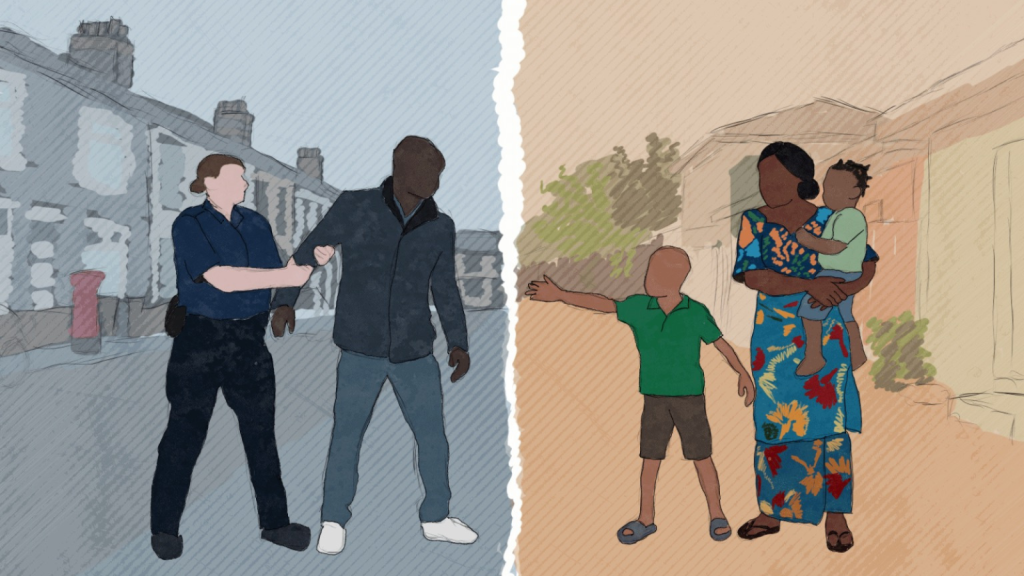


However, climate migrants lack legal protection because they are not categorised as “refugees” and therefore do not qualify for asylum under traditional refugee definitions.
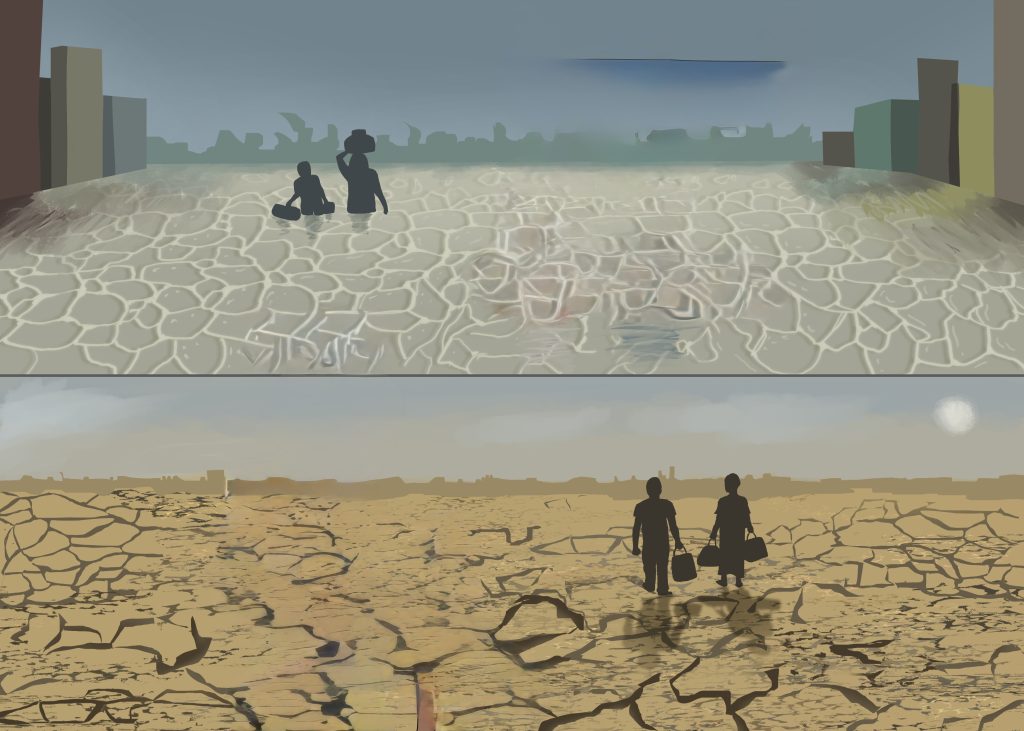
From the worsening climate change effects in the Sahelian G5 to extreme weather events such as the South Sudan floods, record-breaking heatwaves in Kenya, as well as extreme water shortages in Ethiopia and Chad, climate-induced disasters have, over the past 10 years, caused about 250 million internal displacements, averaging about 70,000 displacements every single day. Globally, about 40% of land has been degraded, impacting nearly half of the global population and putting biodiversity, access to water for drinking and irrigation, food security, and livelihoods at serious risk. This has contributed to the displacement of over 3 million people and left about 11 million people, most of whom are in Africa, in need of urgent humanitarian assistance.
Nowhere is this crisis more critical than in the lives of the youngest victims, as it is estimated that nearly half of the world’s children—about 40%—are at risk of the impacts of climate-induced disasters. In Ethiopia alone, the 2022 drought forced more than 320,000 children to be displaced across the country. However, as the number of countries facing extreme climate change hazards is projected to rise from 3 to 65, the lingering concern that remains largely unaddressed is the absence of a legal asylum category for the millions of people, especially Africans, displaced solely by climate-induced incidents.
The Legal Vacuum Facing Climate Migrants
Both “climate refugees” and “environmental refugees” are ubiquitous terms that have been used in international migration discourse for decades but are not tied to any legal obligations. With the ongoing climate-induced polycrisis in Africa, migration is increasingly becoming an adaptation and survival strategy. However, climate migrants lack legal protection because they are not categorised as “refugees” and therefore do not qualify for asylum under traditional refugee definitions.
The primary obstacle to protecting climate migrants is the rigid 75-year-old definition of a refugee under the 1951 Refugee Convention, which requires an individual to prove a “well-founded fear of persecution” by a human actor based on race, religion, nationality, or political opinion. Because “nature,” which causes mass displacement and migration, cannot be a persecutor under current international law, millions of Africans fleeing uninhabitable lands are left in legal limbo, often classified as economic migrants and denied the right to asylum.
What this gap reveals is that the millions of Africans projected to be on the move by 2050 already exist in a grey zone. They are moving but remain legally invisible. There is no recognised category for climate-induced displacement, so people whose farms have failed, whose lands and shelters have been destroyed, or for whom heatwaves and droughts have become unbearable are only pushed into the category of economic migrants. This label denies them protection, excludes them from global climate discussions, and exposes them to restrictive immigration regimes in the U.S. and Europe. What we are witnessing is not just a migration challenge, but a legal erasure of people displaced by forces beyond their control.
Climate Change as a Driver of Forced Mobility in Africa
While conflict unarguably remains the primary cause of long-term displacement across the African continent, environmental disasters have taken the stage as the fastest-growing cause of new human mobility. In Sub-Saharan Africa, about 2.6 million people were forced into displacement in 2021. Research has indicated, for instance, that prolonged droughts in East Africa have resulted in widespread crop failure, loss of livestock, and severe food shortages, pushing many people to leave their homes and migrate in search of food and water. The drying up of Lake Chad alone caused about 2.3 million displacements around Nigeria, Chad, and Niger. This is also evident in the over 1 million displacements of people due to extreme droughts in Somalia.
By 2024, it was reported that approximately 7 million people were affected across West and Central Africa due to flooding, resulting in the internal displacement of over 1 million people across 11 of the 16 affected countries. The G5 Sahel countries—Niger, Mali, Burkina Faso, Chad, and Mauritania—are currently experiencing an extreme climate change polycrisis, characterised by prolonged heatwaves, persistent droughts, soil degradation, high temperatures, frequent flooding, and reduced agricultural productivity.
Environmental degradation is not peculiar to the Sahel, as about 75% of Africa’s land area in its entirety is deteriorating, thereby causing climate-related displacement. With over 70% of the African population dependent on climate-sensitive activities such as agriculture for their livelihoods, climate variability and extreme weather events undermine agricultural productivity and food security, resulting in further displacement and heightened vulnerability among farming communities. More worrying is that these current displacements are only the prologue to a much larger demographic shift, as the World Bank projects that climate change could displace as many as 86 million Africans by 2050.
Africa’s Regional Responses and Their Limitations
The legal landscape in Africa is not entirely exclusionary. While the 1951 Convention offered a dead end, the 1969 OAU Refugee Convention introduced important progress through its inclusion of “events seriously disturbing public order.” A decision by the UN Human Rights Committee also emphasised that countries hosting climate migrants must not return them to life-threatening conditions, reinforcing the principle of non-refoulement.
While this ruling provides a defensive shield against forced return, African leaders have sought proactive solutions through the Kampala Declaration on Migration, Environment and Climate Change (KDMECC), which evolved from a regional initiative in 2022 into a continental roadmap (KDMECC-AFRICA) in 2023.
However, the fundamental flaw of KDMECC-AFRICA lies in its reliance on soft-law declarations rather than a ;binding legal status. The expanded Declaration elevates the issue at the continental level, however, its commitment to “engaging multilateral development banks for financing” remains a voluntary economic gesture rather than a legal obligation.
Fortress Policies in the United States and Europe
As of early 2026, the United States has shifted towards a “fortress” approach to human mobility. While the 2021-2024 period witnessed rhetoric on climate migration, the current administration has reversed course. Following Executive Order 14163, which suspended refugee admissions in early 2025, the U.S. finalised a record-low refugee admissions ceiling of 7,500 for fiscal year 2026, the lowest in the 45-year history of the programme.
More critically, the U.S. has withdrawn from the United Nations Framework Convention on Climate Change (UNFCCC) and several international organisations as of January 2026, effectively dismantling the climate migration framework previously championed by the State Department. For African climate migrants, the U.S. now offers no viable legal pathway, instead expanding travel bans and vetting standards that frame climate-driven movement as a security risk rather than a humanitarian necessity.
Simultaneously, the European Union has doubled down on a strategy of “externalisation”. Under the EU’s New Pact on Migration and Asylum, fully operational from June 2026, the focus is on preventing arrivals by funding third countries to intercept migrants before they reach European shores. Even though these countries acknowledge the impacts of climate change, their legal frameworks remain focused on deterrence and deportation, ensuring that those uprooted by environmental collapse remain legally invisible at the border.
Towards a Regional Climate Mobility Framework
African policymakers should move beyond fragmented declarations and develop a binding regional climate mobility framework that explicitly recognises climate-induced displacement as a ground for protection. This framework could build on the Kampala Convention by expanding its scope beyond internal displacement to include cross-border climate mobility.
Also, the African Union and its member states should clarify and operationalise the 1969 OAU Refugee Convention’s provision on “events seriously disturbing public order” to explicitly include severe climate-related disruptions. Environmental collapse that destroys livelihoods, food systems, and habitable land increasingly meets this threshold even in the absence of armed conflict.
Moreover, while initiatives such as KDMECC-AFRICA represent important political acknowledgment, their reliance on voluntary commitments limits their impact. African governments should prioritise transforming these policy roadmaps into binding regional instruments with enforcement mechanisms and accountability structures. Climate displacement is not merely a financing issue; it is a legal protection issue.
The African diaspora is also more than a source of remittances; it is a powerful diplomatic bloc. Diaspora organisations should be empowered to lobby for climate mobility visas and skills-transfer programmes in the Global North. By acting as bridge-builders between African realities and Western policy, the diaspora can challenge fortress approaches and advocate for humanitarian recognition of climate-driven displacement.
Climate displacement in Africa is not a peripheral humanitarian concern. It is a present and worsening reality driven by environmental degradation that has rendered livelihoods untenable and territories uninhabitable. Yet, as millions are forced to move, legal systems centred in a world where persecution is valid only in political and military terms.
This is not simply a policy gap but legal invisibility. African climate migrants exist physically, statistically, and socially, but not juridically.
For Africa, the challenge is not only to demand fairness from the Global North, but also to lead in crafting regional protection systems that recognise climate displacement as a legitimate ground for mobility.
Writer:  Isah Kamisu Madachi
Editors: Amaka Obioji, Chimee Adịọha
Image:   Uchenna Anikwe for Diaspora Africa