

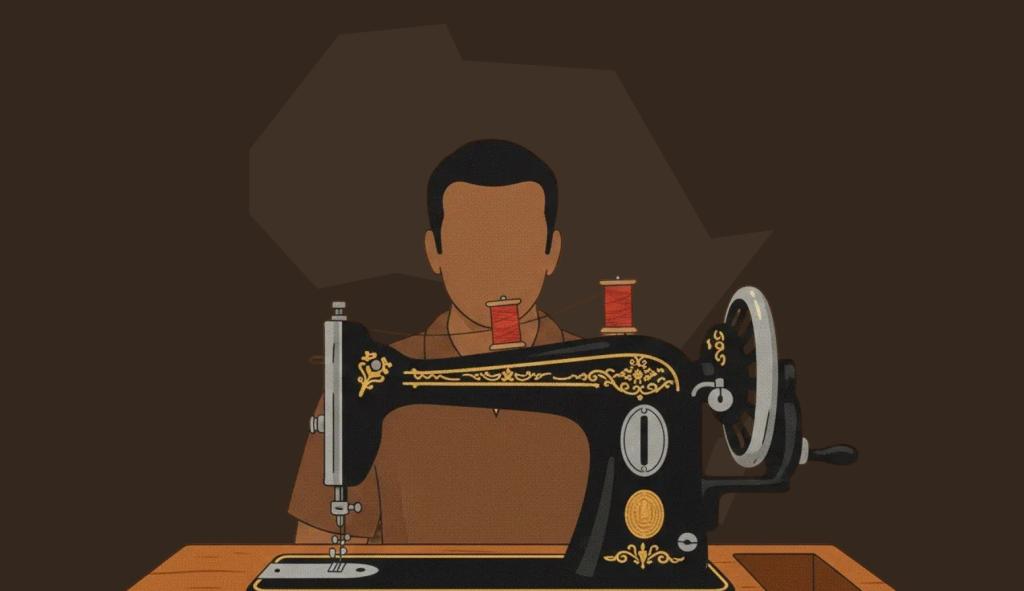
Leaving his family with high hopes, Buhari, a Nigerian tailor known in his community in Kano, has found a new home in neighbouring Mali, serving many through his exquisite tailoring under the company he works for. Gripping his dream, he now believes that dreams are like windfalls if one is blessed with opportunities like his. “I don’t feel I’m away from home because I have found a place where my skills are much appreciated”, Buhari said. Even though some days are wrapped with nostalgia, remembering that he gets enough funds to support his family makes him thrilled and more optimistic about what the future holds. He’s also made a new family there. Whenever a new person joins them there, their family expands.
Harsh economic condition in Nigeria is no longer news to many in the country. It comes as no surprise to people who already have their relations abroad, those who have joined the ‘japa’ bandwagon. While the journey is desperate and uncertain for many, others like Buhari go with certainties, realising hopes and dreams they have longed for. Even finding the greener pastures with lush and warmth, receiving them.
Before departing Kano for Mali via road, Buhari had already secured a job with a tailoring company in Bamako, which had outsourced him here. He was promised accommodation, two square meals per day and a staggering amount of N950,000 monthly. These were all fulfilled upon his arrival. Even the travel fare of N350,000 he used was settled when he reached Bamako.
Better Lives and Realising Dreams
In Kano, a set of male clothes sewn by Buhari costs N3,500. And, living in a community of low-income earners, with little pay, usually sums up his monthly take-home to be a little over N50,000. Although the take-home rises due to festivities like Eid celebrations, it is still not enough to cater for his wife, two children and expectant relatives.
“Because of transport fare to my shop, household demands, food, sewing materials and petrol for the generator, which have all skyrocketed, I am only left with a little over N50,000 monthly, if I am lucky sometimes”, he said, adding that this prompted him to welcome the idea of moving to Mali. Buhari is not alone. Niger has also welcomed many Nigerian tailors in its bustling cities like Niamey, Maradi and Dosso, among others. According to Mahmud, a tailor currently in Kano state, most of his employees and friends have travelled in search of greener pastures, and they have indeed made it.
A February 2025 report by the International Organisation for Migration (IOM), through its Flow Monitoring (FM) tool, which is part of the Displacement Tracking Matrix (DTM), collects data at key entry, exit, and transit points to better understand population movements across West and Central Africa, stated that “In the southwest of Niger, during February 2025, Nigeriens were the main nationals observed (74%), followed by Nigerians (18%), Malians (3%), Burkinabés (2%), and other nationalities (3%). Outgoing flows accounted for 44 per cent of total movements, incoming flows 43 per cent, and internal flows 13 per cent.” These Southern cities include Niamey, Niger, and Dosso.
Mahmud recounts that they have received the influx of many Nigerian tailors who are mainly Hausas, including his friends and employees. As an employee tailor, sewing women’s clothes, you are offered at most N2,000 per set in Nigeria. At the end of the month, a junior tailor can get about N30,000 if he works hard enough. Also, a large number of the bosses do not care about the food that you eat at work, transport fare or accommodation, as most of the employees come from their homes. Mahmud also narrates that with this little income, one has to save and address unforeseen problems.
Tailors who decide to sew women’s clothes in Niger get at least N7,000 per set – a skirt or wrapper and a blouse. Increasing their monthly take-home tremendously, unlike what they were used to back in Nigeria. In both Niger and Mali, food options that were once a luxury in Nigeria were affordable. Although Mahmud has not been there yet, he has received stories of how fresh and better the food over there is. He has also seen firsthand how they send money back home regularly. “One of my friends even bought a land here in Kano worth N350,000 after his first three months in Niger. He is really doing well since he left.”
On Buhari’s part, his family is blossoming. He can now send his wife N70,000 monthly to take care of the family. His expectant relatives also get some gestures during celebrations, as he can contribute. Over there, he gets breakfast and dinner from the company, while he spends a little on lunch. In the car parks in Kano, you would find people giving delivery parcels to connecting drivers going to Niger or Mali. This is because sewing materials are cheaper here. Hence, tailors and the companies send money to trusted individuals like Mahmud to purchase items as zips, threads and even sewing machines, among others. He states that tailors can purchase items worth N10, 000, 000 at a go. “I do carry out such tasks to earn more here”, says Mahmud. Even though the countries have notable reputations for being transit routes to Europe and the Middle East, tailors like Buhari and others have realised their dreams there.
Tailors on the Move
In the last three years, more than 10 employees of Mahmud have left his shop for either Niger or Mali. He has recently also gotten a job with another company in Mali through Buhari, but remains sceptical about going. The idea of leaving Nigeria is still maturing in his mind. He also hears weekly from most of his employees. But, he is scared of leaving his small family and other responsibilities as the eldest in the family. Some tailors go with the intention of gathering enough money so that they can come back and expand their business here by investing more. Most of the people who have gone there have gone with that intention, says Mahmud. However, the comfort they meet there keeps them even longer than they had planned. He explains that among the employees who left his shop for either of the two countries, some come back to visit their families yearly, while a few have been living there for over 3 years. They don’t even show signs of coming. “From our video calls, you can tell they are enjoying their new lives. They’ve gained weight and look fresh”, he said.
With the success of others, these paths will continue to attract others. As it is, many are learning the intermediary tailoring skills in Nigeria to join their friends and family in either Mali or Niger. The faster they learn, the higher the chances of moving sooner.
Writer: Nusaiba Ibrahim
Editors: Beatrice Nwoko, Amaka Obioji
Image: Diaspora Africa